Paul Cavey
Japan – broad-based inflation
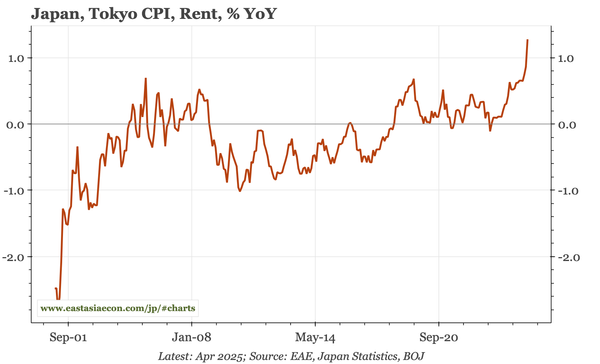
Tokyo CPI in April was boosted by changes in official subsidies. But inflation remains broad-based. Food prices were up, and rental inflation jumped – important, given the near 25% weighting. Services inflation didn't shift much, but the trend will be clearer with April national CPI and SPPI.
Japan – services PPI inflation still over 3%
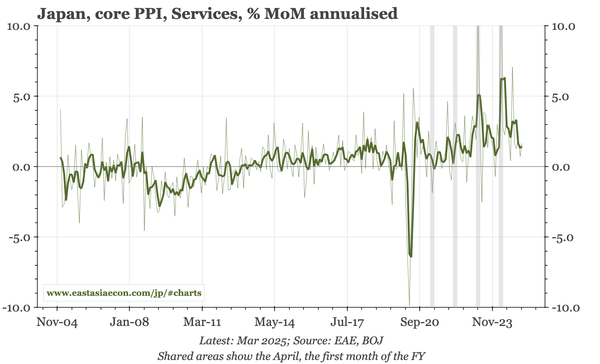
YoY services PPI in March continued to run at above 3%, led by price rises in more labour-intensive sectors. Sequential momentum has eased a bit in recent months, but should get another boost in April, as the latest annual wage round feeds into price rises at the beginning of the new fiscal year.
Korea – business sentiment worsens again
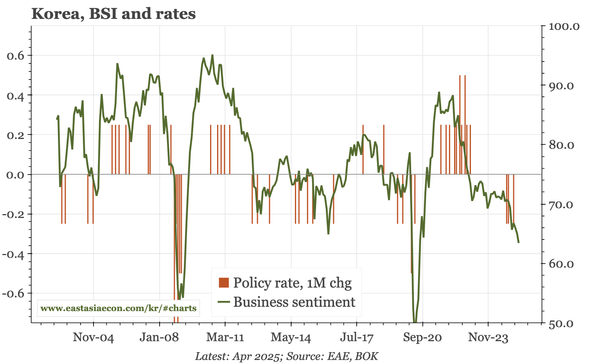
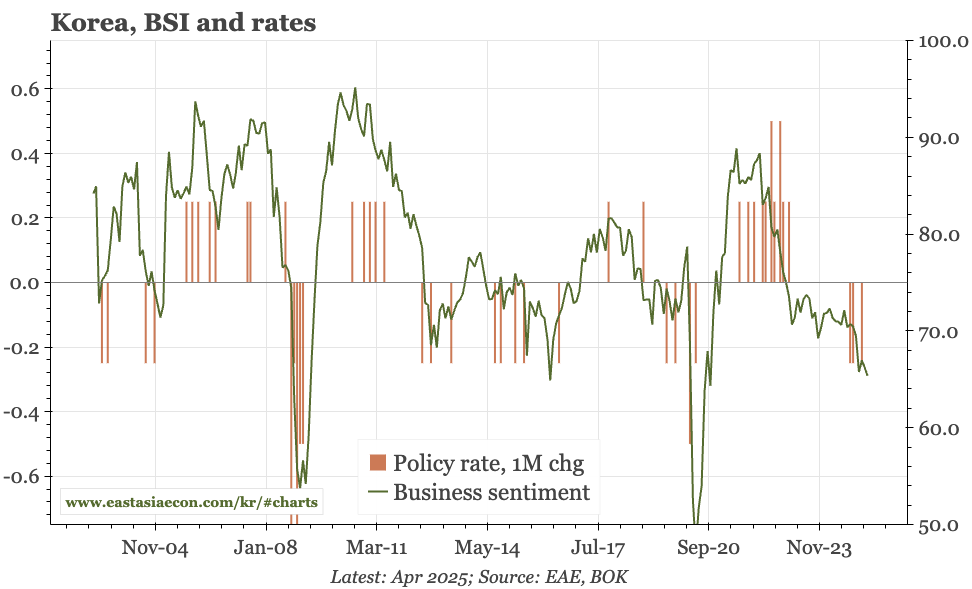
Business sentiment fell again in today's survey, and has now only been worse during the global financial crisis and covid. Exporter sentiment has ticked-down, but the weakness is much more apparent in domestic, non-manufacturing sectors. Further policy easing is ahead.
Japan – PMI surprisingly stable
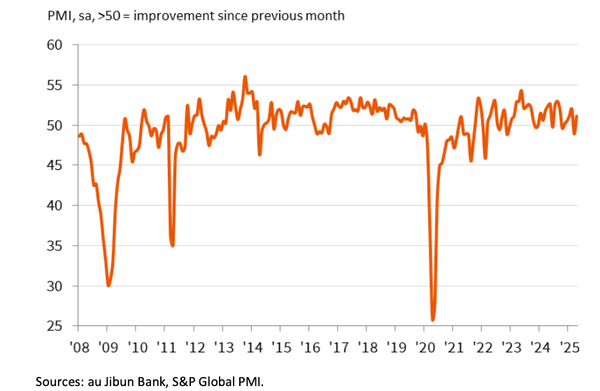
As with the Reuters Tankan, the S&P manufacturing PMI didn't fall in April. The services PMI also rebounded, and the commentary shows no sign in the trend: "inflationary pressures strengthened, with input prices rising at the sharpest pace since February 2023 and output charges increasing solidly"
Taiwan – how to cope with the US shock
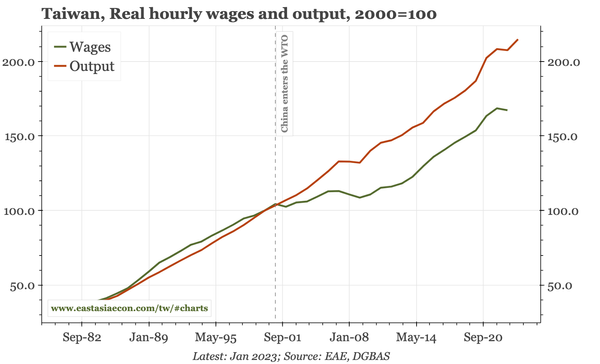
Taiwan macro doesn't attract much attention, but its experience matters. Taiwan was most exposed to the 2000s China shock. That it then suffered near-deflation reflected tight fiscal policy, a lesson that needs to be learnt in dealing with the latest shock, this time emanating from the US.
Korea – consumers still depressed
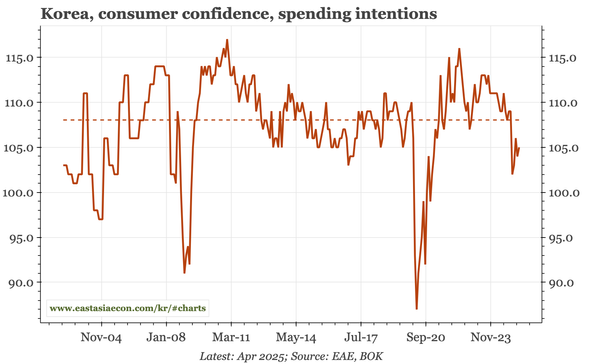
The clearing of some of Korea's political uncertainty hasn't helped consumer confidence. It hardly rose in April, even though the survey was taken after Yoon's impeachment verdict. Inflation expectations remained near 3%. Property price expectations also ticked up, but not as quickly as in March.
Japan – four reason why the JPY hasn't helped exports
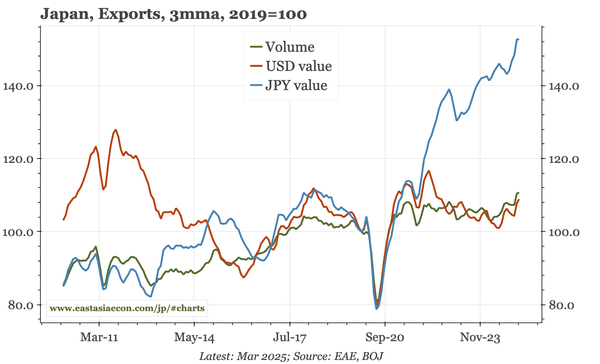
Export volumes have ticked up this year, but not by enough to think that JPY weakness is finally boosting sales. That has a silver lining: just as JPY weakness didn't boost real growth, a strengthening currency won't lead to much deterioration. There will, however, be an impact on nominal earnings.
Taiwan – labour market constrained by supply
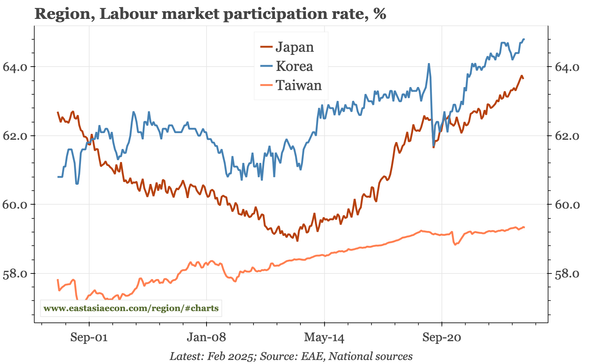
Taiwan isn't seeing the big supply-side labour market shifts visible in Japan and Korea. The participation rate hasn't risen, and the proportion of part-time jobs remains in low single digits. As a result, ageing is constraining labour supply in a way that hasn't been apparent elsewhere.
Korea – PPI easing with import prices
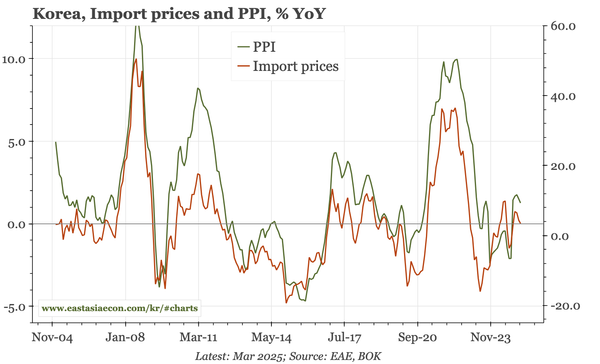
Japan shows signs of pent-up inflationary pressure, with PPI rising despite a decline in import prices. In Korea, by contrast, the usual relationship hasn't broken. If USD strength really has ended, KRW import prices will decline further, making it easier for the BOK to focus on the weak cycle.
Korea – exports down again so far in April
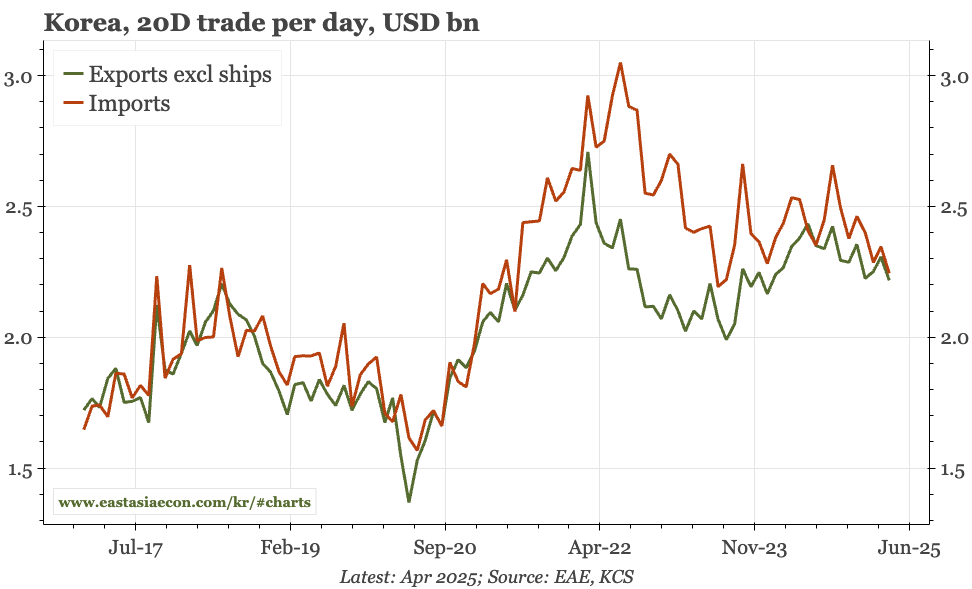
Exports for the first 20 days of April were weak, falling -5.2% YoY. That isn't because of tariffs: the downcycle in Korean exports began in mid-2024. With tariffs, however, the weakness in exports can be expected to intensify. The equity market is already pricing in double-digit declines.
Region – how far will exports fall?
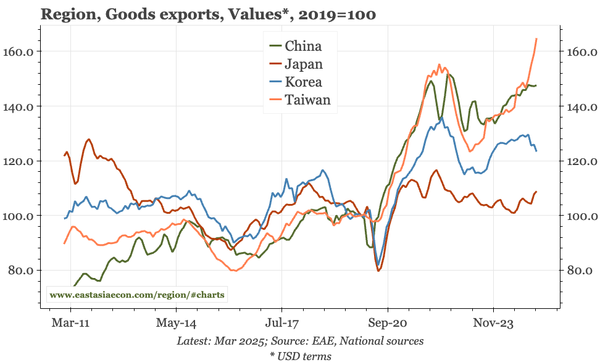
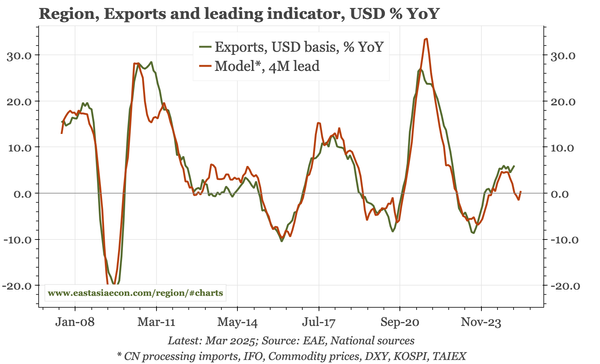
My leading indicator suggests a clear rolling over of the export cycle even before the real hit from tariffs begins. It might be a bit too early yet for that hit to be showing up in hard export data, but next Monday's trade statistics for Korea for the first 20 days of April will be a test.
Japan – part-time wage growth jumps in March
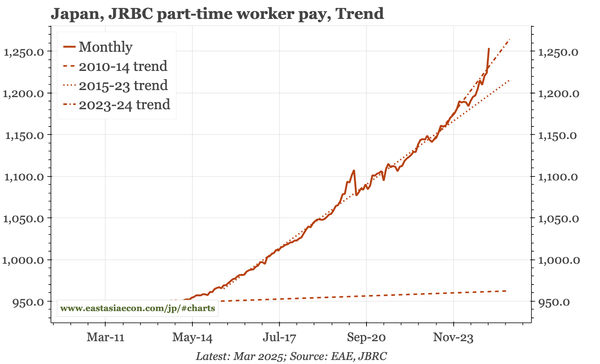
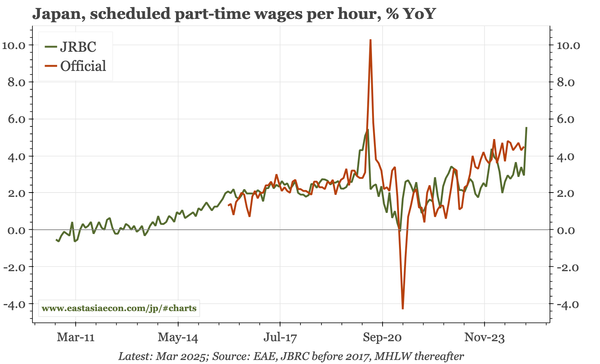
JBRC this week reported March part-time wage growth jumping to 5.6% YoY. Some of that looks like catch-up with the official data, but the commentary was interesting, with the rise being attributed in part to this year's shunto. The labour market continues to look very tight.
Japan – cycle holding up, so far
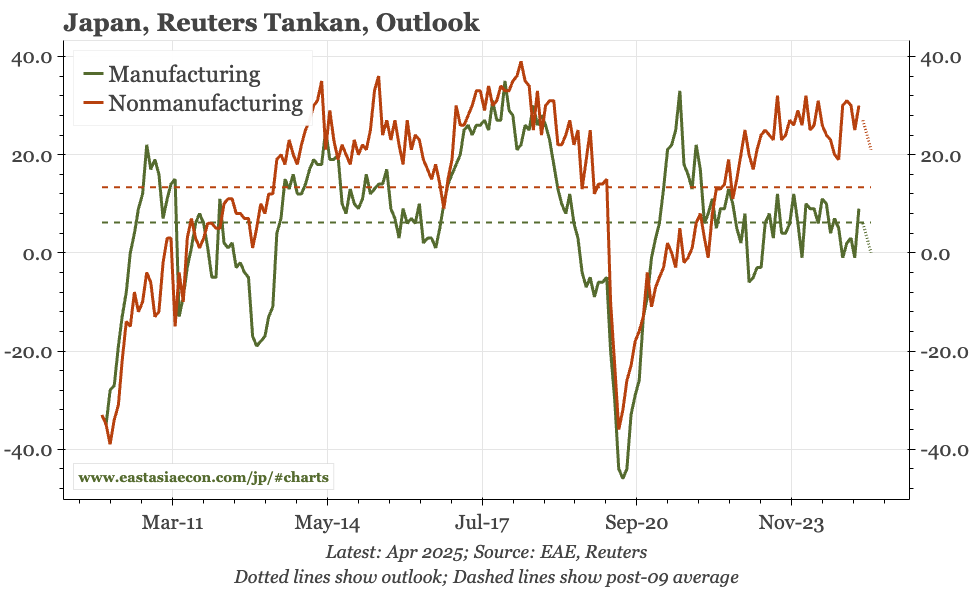
Bits and pieces today. Machine orders were stable in February. The April Reuters Tankan didn't show much deterioration, even though the survey was conducted after "Liberation Day". At least for services, one continued driver is tourism, with visitor numbers in Q1 surpassing 10m for the first time.
China – 5.4% isn't enough
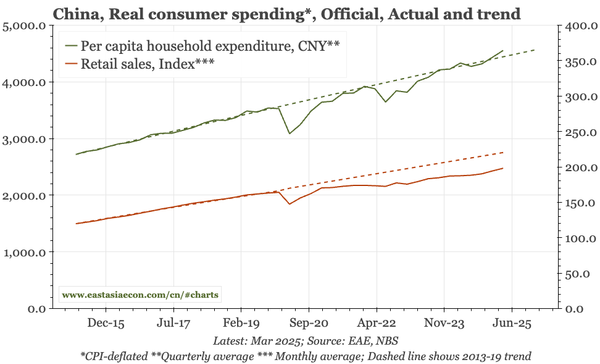
Since June last year, there has been a real inflection in retail sales and some construction indicators. In Q1, however, real estate remained as weak as ever. Manufacturing FAI is strong, but that has to be at risk from the trade war. Overall, the economy still isn't on a firm footing.
China – all-economy prices still falling
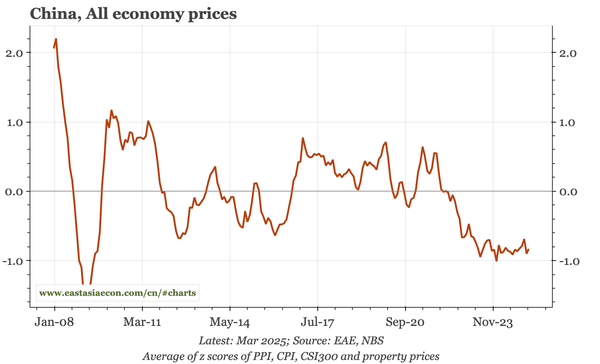
Today's property price data showed continued falls in March, though not as deep as the cuts late last year. Putting that with CPI, PPI and equities, and it is clear that all-economy prices remain in deflation, with little change following the government stimulus from September last year.
Korea – import price inflation and the KRW
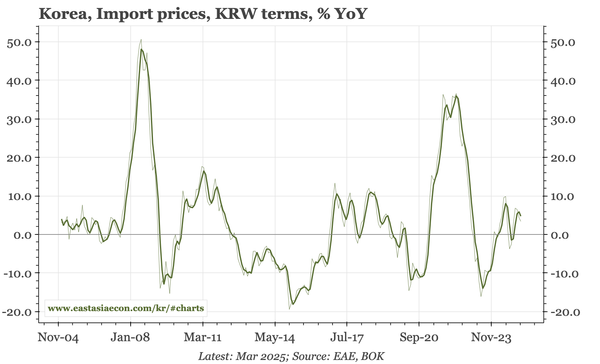
KRW import price inflation has slowed to 3.4% YoY. In USD terms, import prices are falling. The gap is the exchange rate, and that boost to inflation makes the KRW an issue for the BOK. The KRW has now recovered the drop triggered by the martial law declaration, easing some of the BOK's concern.
China – policies to boost consumption
The second of two videos on consumption, an issue that is even more important given the economic damage that will be inflicted on China by the tariffs. It is impossible to imagine Beijing supporting western-style consumerism. But there is still a way for economic policy to boost consumer spending.
Korea – cycle worsening, rates to fall
The economic environment for Korea is about as bad as it can get. Despite the short-term rebound in house prices, that suggests more rate cuts, starting at this week's meeting, that will ultimately take the policy rate below neutral. The one caveat I have is the stickiness of services inflation.
Taiwan – 4% wage growth
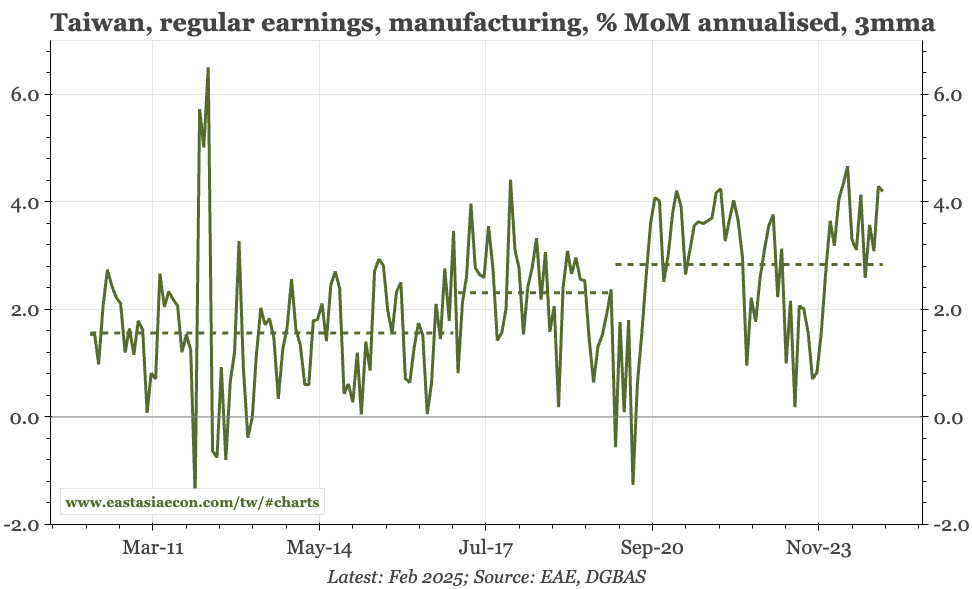
Wage growth in Taiwan has been famously low for years. But in manufacturing, there are signs of change, with growth averaging around 4% since 2024. Services isn't so strong, but the trend growth in economy-wide wages is now up to 2.5%, higher than any time in the 25 years.
China – import ratio now the lowest since the 1990s
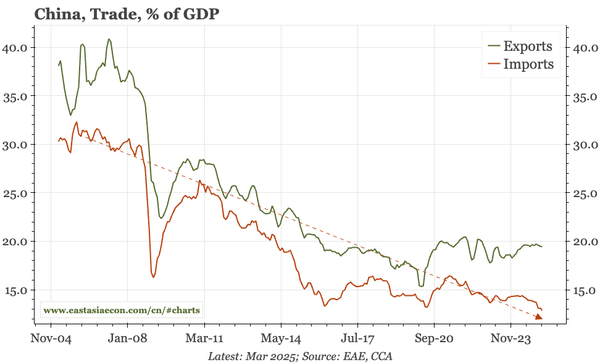
Exports through March were solid, but not so strong as to suggest big front-loading. The real standout is the import ratio dropping to a new post-1990s low. The trade surplus upsets Trump. Equally though, weak imports limit China's appeal as a market for others looking for an alternative to the US.