Archive
East Asia Econ Paul Cavey

Japan – solid GDP

Japan – solid GDP

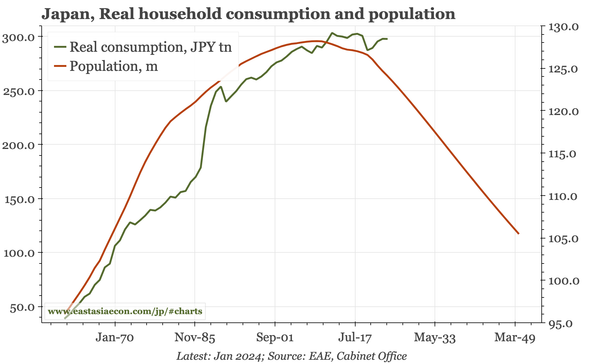
Q2 GDP wasn't particularly impressive at headline level, but the details were firmer, with both consumption and investment rising. The recovery in aggregate consumption does remain sluggish, but that is partly because of population loss. I estimate per capita consumption in Q2 reached a record high.

2 min read

Korea – import prices fall, auto export prices fall more

Korea – import prices fall, auto export prices fall more

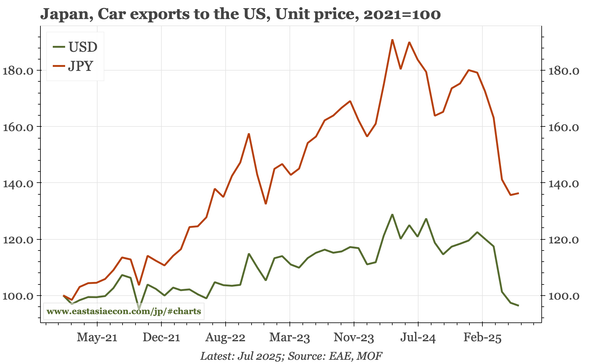
Preliminary data show the recent fall in import prices lost momentum in July, but still point to more downside for CPI goods prices in the next 3M. Overall export prices were flat, but for autos show the same sharp decline seen in Japan. Asian auto firms – so farm – are absorbing much of the tariffs

1 min read

China – credit data soft, but M1:M2 ratio stable

China – credit data soft, but M1:M2 ratio stable

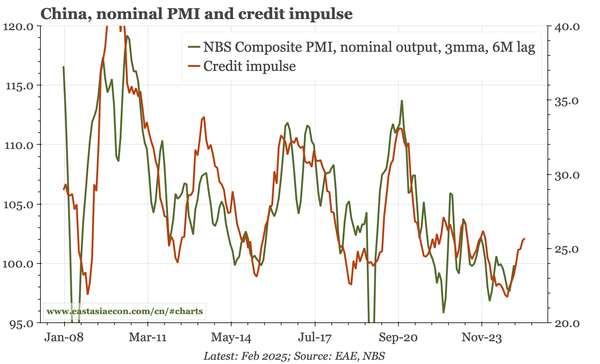
I missed this release earlier today. The rise in the credit impulse stalled in July, dampened by slower government, non-state and mortgage borrowing. However, the monetary data remain a bit more constructive: while the recovery in M1 growth slowed, the bottoming relative to M2 remains intact.

1 min read

Korea – labour market still soft

Korea – labour market still soft

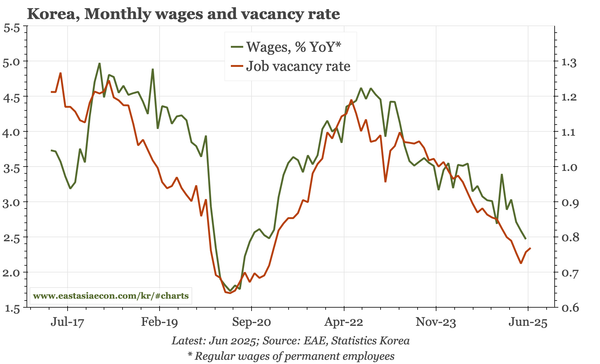
The rise in optimism that followed the election in early June of a new government isn't yet feeding into a meaningful improvement in labour market data. One of the missing ingredients is that the rise in confidence seen among consumers hasn't yet spread to the corporate sector.

2 min read

Taiwan – tight labour market, at least in manufacturing

Taiwan – tight labour market, at least in manufacturing

The export surge is boosting demand for labour, with data today showing manufacturing overtime hours in June near the highest in 15 years, and wage growth of close to 4% YoY. Overall wage growth has also trended up, but less quickly, because the demand:supply balance in services isn't as tight.

1 min read

Korea – exports stable in August

Korea – exports stable in August

After adjusting for workdays, export growth remained solid at around 9% YoY in the first 10 days of August. The growth is all because of semi and ships – exports of other products fell. That perhaps shows an end to front-loading, though exports to the US directly haven't been particularly volatile.

1 min read

Last week, next week

Last week, next week

Data themes remain unchanged. As tariffs – perhaps – stabilise, official sentiment is catching up to the data in Japan, with growing concern about inflation. In China and Korea, market sentiment has improved ahead of the data. Given Trump's desire for a deal, that's probably more justified in China.

5 min read

China – the end of core deflation...or is it?

China – the end of core deflation...or is it?

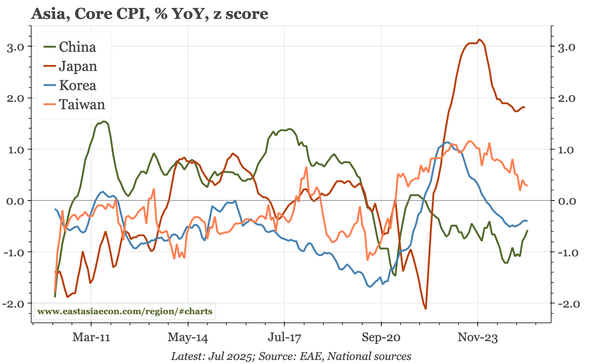
Today's official data show core CPI has rebounded to almost +1%. That would be an important change, but at best it looks narrow, with almost all the rise coming from "miscellaneous goods and services". The leads from PPI and the PMI remain soft. Separately, yesterday's CA data for Q2 were stable.

3 min read

Taiwan – export surge continues

Taiwan – export surge continues

The surge in exports continued in July. Exports have now grown 30% just this year, and the trade surplus has risen to 20% of GDP. But the underlying dynamics shifted last month. Rather than semi exports to the US, the big driver was other exports to ASEAN. That looks more like tariff front-loading.

1 min read

Japan – inflation concerns grow

Japan – inflation concerns grow

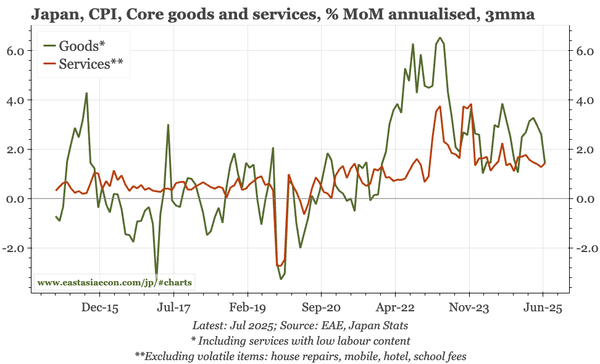
Today's EW survey suggests stabilisation of sentiment following the sharp deterioration through Q1. As that happens and high-frequency price measures stop falling, officials, both on the BOJ MPC and in the wider government, are expressing more concern about the continued strength of inflation.

4 min read

Korea – super-ageing

Korea – super-ageing

The BOK recently published a report on the consequences of Korea's "exceptionally rapid" ageing: lower real rates, lower inflation, and weaker financial stability. The report is interesting, but the wide range of reforms suggested shows just how difficult it will be to head off those consequences.

4 min read

Japan – consumption growing at pre-covid trend

Japan – consumption growing at pre-covid trend

The BOJ's consumption proxy ticked up MoM in June. That followed a dip in May, so in Q2 as a whole consumption is only just higher than Q1. Based on the BOJ's data, in level terms, aggregate consumption is still 7% smaller than at the end of Q319. But the growth run-rate is now similar to pre-covid.

1 min read

China – imports perk up

China – imports perk up

Overall exports still don't show a tariff hit, with shipments to ROW offsetting the weakness of direct sales to the US. Imports are more interesting, with signs emerging of an upturn. That so far is (very) mild, but has been enough to cap the trade surplus, albeit at the high level of USD100bn.

2 min read

Taiwan – TWD appreciation pushing down prices

Taiwan – TWD appreciation pushing down prices

The biggest takeaway from today's July price data is the big fall in TWD import prices – and thus PPI and goods in CPI – on the back of currency appreciation. Core actually ticked up in July, and probably isn't going back to the sub-1% rate of pre-covid. But I doubt it gets back above 2% either.

1 min read

Japan – solid wage data

Japan – solid wage data

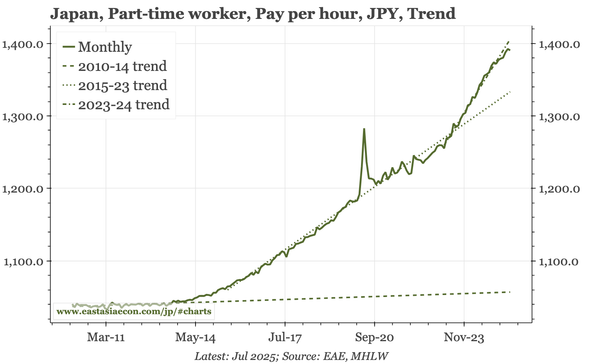
The shunto has boosted full-time regular wages, which increased more quickly in May and June than last year. Part-time hourly wage growth has also picked up again, and will get a further boost from the recently announced hike in the minimum wage. But for now, real overall wages are still falling.

2 min read

Korea – inflation still stable

Korea – inflation still stable

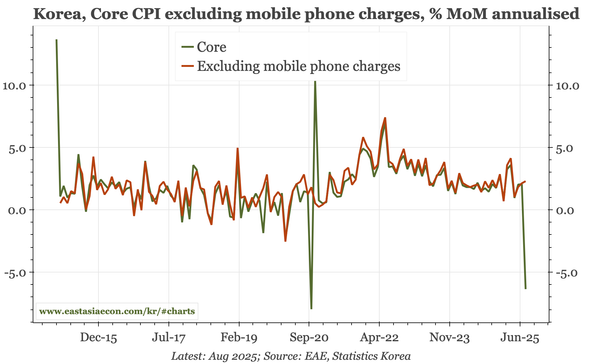
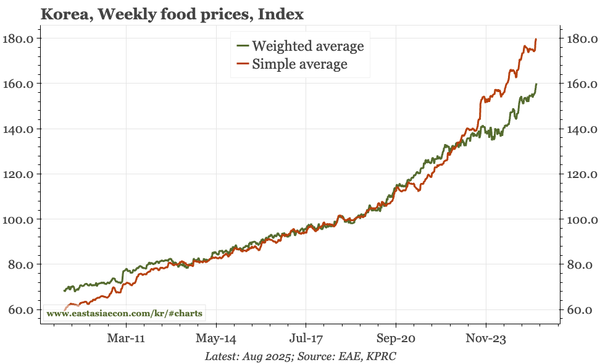
The BOK hasn't sounded concerned about inflation for a while, and the July CPI data is unlikely to change that, with headline and core remaining close to 2%. Food prices will rise in August following the recent bad weather, but energy prices should fall. Core is also now starting to look softer.

2 min read

China – the CNY and deflationary equilibrium

China – the CNY and deflationary equilibrium

Deflation looks like 1990s Japan. But China's exchange rate doesn't. Real CNY depreciation helps exports substitute for the weakness of domestic demand in a way that didn't happen in Japan. It also postpones the sort of stimulus that would ease deflation and provide more direction for markets.

5 min read

China – the trade surplus, the CNY and autos

China – the trade surplus, the CNY and autos

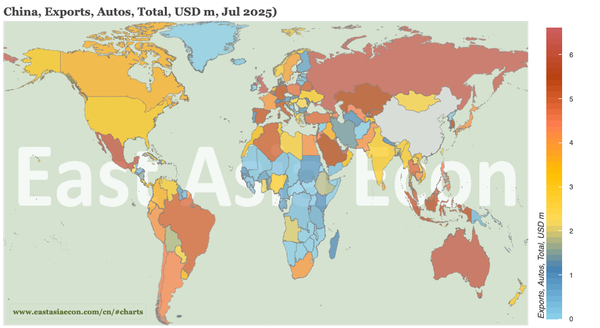
Two things. First, my latest video, discussing what's not surprising about the trade surplus (the rise in capital goods), and what is (that for exports China's global market share gains have accelerated, while for imports, they've fallen). Second, an interactive dashboard on China's auto exports.

1 min read

Taiwan – PMIs point to tougher 2H

Taiwan – PMIs point to tougher 2H

The PMIs haven't been great lead indicators this year: they've been mainly below 50 in Q2, and yet export data have been absurdly strong. Some of that is because the export story has become so concentrated in semiconductors. Still, it is likely that the real economy will be quite a lot weaker in 2H.

1 min read

Japan – the BOJ focuses on tariffs and food prices

Japan – the BOJ focuses on tariffs and food prices

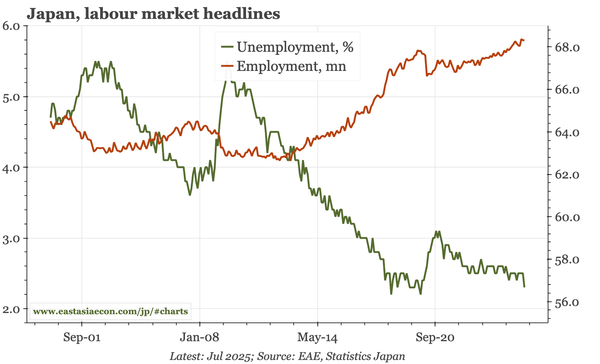
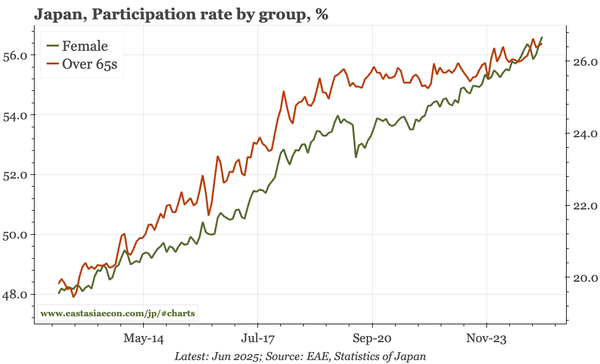
Unusually, the BOJ's quarterly outlook report doesn't focus on wages and inflation. Instead, it looks at this year's two shocks – tariffs, and food prices. The bank argues that the rise in the part rate, seen again in today's June labour market data, has helped offset the impact of food prices.

4 min read

Korea – exports better, but sentiment weak

Korea – exports better, but sentiment weak

The lift in exports in June was sustained in July. But I'd be sceptical that marks the start of an upcycle. The strength is all about semis, and today's PMI, like last week's BOK business sentiment survey, was sluggish. If there are upside risks for Korea, they are likely domestic, not external.

2 min read

Taiwan – more amazing data

Taiwan – more amazing data

It isn't news, but the strength of exports in today's GDP release is still eye-catching. It keeps Taiwan on the much higher post-2020 plane of growth. But with consumption weakening, GDP is now almost all about exports. If there's been lots of tariff front-loading, 2H25 will look very different.

1 min read