Archive
East Asia Econ Paul Cavey

Japan – inflation up again

Japan – inflation up again

The BOJ today was a bit less worried about tariffs, and a bit surer on inflation. That keeps a rate hike as a probability for later this year. But macro remains messy, with considerable disagreement about the contents of the US-Japan "deal", and consumer inflation expectations ticking up in July.

3 min read

Korea – less bad in June

Korea – less bad in June

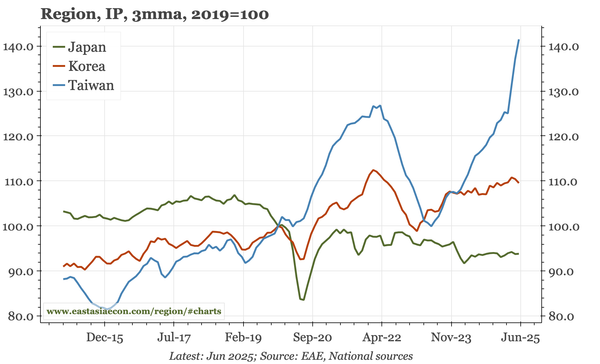
June data continue to suggest retail sales have bottomed. There was also a decent bounce in construction last month. Industrial and services output are creeping up. However, production overall remains in the range of the last 23M. So, while a bit less vulnerable, the cycle hasn't yet lifted.

1 min read

China – weak PMIs again

China – weak PMIs again

The weakness was true even for pricing, which is the focus of the most recent policy push: input prices did improve MoM, but not to over 50, and output prices fell further. That Beijing has turned its attention to oversupply should help equities, but I am doubtful that alone produces macro recovery.

2 min read

Korea – labour market still softening

Korea – labour market still softening

Today's release of local JOLTS data shows the labour market remained soft in June. Vacancy and quit rates continued to fall, hiring of temp workers eased, and filling rates are trending up The fall in the vacancy rate in particular is a sign that wage growth remains under pressure.

1 min read

Korea – growth v household debt

Korea – growth v household debt

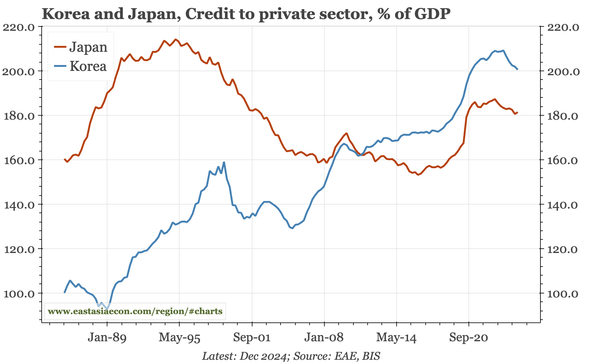
Yesterday's minutes showed the clear tension for monetary policy between weak growth and financial excess. The BOK seems confident that the latest macro-pru measures will work. That sets the stage for more easing, though the committee in July wasn't quite as concerned about growth as it had been.

3 min read

China – another dawn

China – another dawn

Does anti-involution produce macro turnaround when the September combination of stock market and local government bail-out failed? The markets are hopeful. I am more cautious, given China's macro problems are weak demand as well as strong supply. I'd be wrong if household savings behaviour shifts.

6 min read

China – heavy industry still dragging down profits

China – heavy industry still dragging down profits

The government is increasingly focused on the supply-side issue of corporate involution as the driver of unwanted deflation and weak corporate earnings. However, the decline in profits has been led by heavy industry, showing the importance of the weakness of property and aggregate demand.

2 min read

China – export prices starting to rise

China – export prices starting to rise

Based on official data, tariffs have as yet to cause any real reversal in the surge of export volumes that's now been underway for two years. That's even though export prices have, for the first time since 2003, started to rise YoY. It isn't obvious that China is absorbing the cost of the tariffs.

1 min read

Japan – underlying inflation isn't accelerating

Japan – underlying inflation isn't accelerating

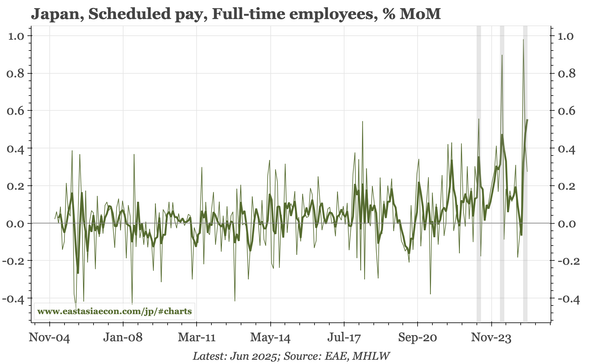
Services prices in Tokyo CPI for July and nationwide services PPI for June, is firm but stable. I am starting to think that the upside risks for inflation I talked about earlier in the year might have played out, though the fall-out from the Upper House election might change that again.

2 min read

Korea – whither the Won

Korea – whither the Won

The underlying dynamic for the KRW has been a fall in corporate borrowing driving a structural increase in Korea's current account a surplus, which has been recycled overseas by a reallocation into foreign assets by the NPS. With that reallocation running out of steam, the KRW has room to strengthen

7 min read

Korea – signs of a floor

Korea – signs of a floor

Q2 GDP was boosted by government spending and doesn't indicate a real turn in the cycle, as today's weak business sentiment survey through July showed. However, while Korea still has to get through the tariff shock, it does at least look like the cycle is no longer worsening,

2 min read

Japan – trade deal and Uchida

Japan – trade deal and Uchida

The trade deal sets the stage – again – for a strengthening of the JPY. That's because the BOJ should be hiking rates further, according to the framework set out by Uchida in his speech today: uncertainty this year has been elevated, but the cycle has remained intact, and inflation has been high.

2 min read

Korea – property price expectations dip

Korea – property price expectations dip

For the further rise in consumer confidence in today's survey to matter, it needs to lift business confidence too. Without that, more important is the dip in property price expectations which, with the SLO survey showing tighter lending standards, should ease BOK concerns about housing overheating.

2 min read

Korea – upstream price pressures weakening

Korea – upstream price pressures weakening

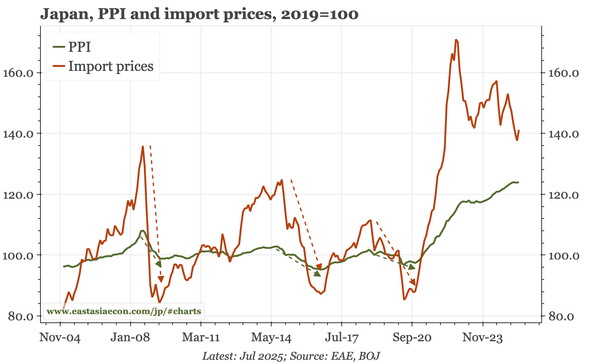
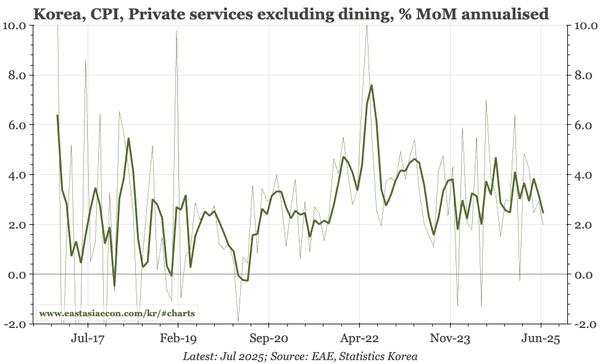
PPI ticked up in June, but only to 0.5% YoY, and overall trends suggest continued moderation of price pressures. That's true for goods, given the further fall in import prices, but is even more relevant for services in light of the widening gap between PPI v CPI services price inflation.

2 min read

Taiwan – TSMC bullish in words, less so in numbers

Taiwan – TSMC bullish in words, less so in numbers

Three things stood out in TSMC's earnings call yesterday: the lack of talk of "tariffs", the bullishness on demand, and confidence on margins despite TWD strength. The message has macro significance, with one risk that while TSMC and the government expects a much slower 2H, that is too pessimistic.

3 min read

Japan – lots of action in CPI, but few implications

Japan – lots of action in CPI, but few implications

In June, headline fell, BOJ core rose, and international core was flat at 1.6%. So, not a clear message...and then there's the uncertainty about tariffs and politics. Some tariff deal – like a TRQ – I think gets the BOJ engaged again. But I don't expect much dovishness without a US recession.

2 min read

Japan – car export prices down again

Japan – car export prices down again

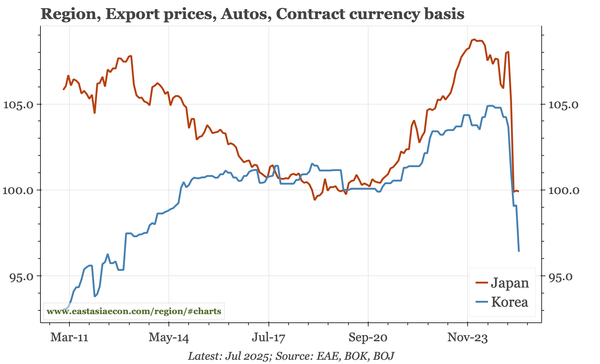
The Q1 tick-up in overall export volumes has ended, but hasn't reversed. That's partly because of the willingness of the auto firms to cut USD prices. However, prices fell less quickly in June than May, and reports suggest the car firms are now starting to raise prices.

2 min read

Korea – the underlying slack in the labour market

Korea – the underlying slack in the labour market

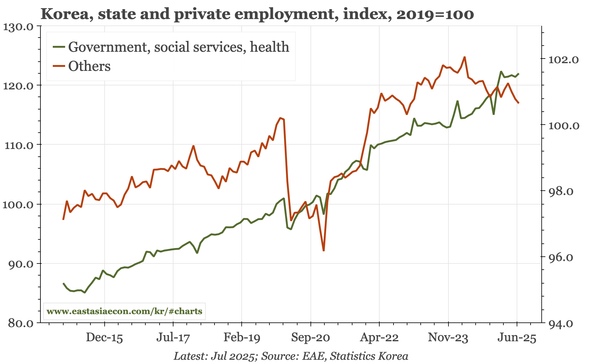
The labour market loosening that is one of the big themes for Korean macro isn't visible in headline data, which show employment high and UE low. It is clearer in a nice box in the BOK's economic outlook report, that discusses in detail why the employment situation is in fact "subdued".

2 min read

Japan – Reuters Tankan remains firm

Japan – Reuters Tankan remains firm

While there's been jitters around tariffs and inflation, business sentiment overall continues to hold up remarkably well, as shown by today's Reuters Tankan. For mfg, weakness in autos is being offset by an improvement in tech. That theme is visible in equities, but not yet in actual export data.

1 min read

China – economy still shifting towards services

China – economy still shifting towards services

Today's release of more details of Q2 GDP are interesting, if puzzling. GDP was held up by a larger contribution from investment, even though construction contracted for the first time since early 2022. The weakness of construction does, however, further the economy's steady shift towards services.

2 min read

Korea – continued labour market slack

Korea – continued labour market slack

The labour market remains slack, with employment dropping in June. Wage growth is also declining, and other data released today show import prices dropping 6% in June. This all suggests inflation will remain constrained, giving room for the BOK to continue to cut rates.

3 min read

Japan – three scenarios for the JPY

Japan – three scenarios for the JPY

My latest video, discussing the JPY outlook in the context of this year's two shocks: tariffs, obviously, but also the rebound in inflation that caused a new sharp fall in consumer confidence. The risk from US policy is still growing, but, importantly, the rebound in prices is losing momentum.

1 min read