*
East Asia Econ

East Asia Econ

The platform for tracking and understanding East Asia macro

China – holiday affecting PMIs

China – holiday affecting PMIs

Both the official and Caixin mfg PMIs fell in January. That doesn't tell us much. When Chinese New Year falls in January, it isn't unusual for the PMI to rebound with the rise in working days in February. The sharp drop in jobs in the Caixin is a concern, but wasn't seen in the official version.

1 min read

Japan – inflation hits consumer confidence, again

Japan  – inflation hits consumer confidence, again

The link between consumer confidence and prices has weakened in the last 18M. But it hasn't broken, as January data show: consumer confidence fell quite sharply this month, as price expectations rose. The implication is that while nominal wages are rising, they still aren't going up quickly enough.

1 min read

Japan – upstream services inflation still rising

Japan – upstream services inflation still rising

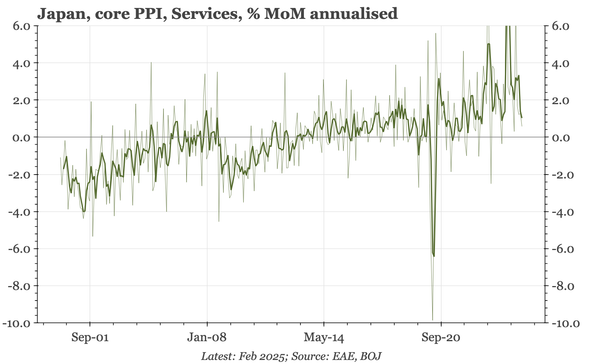
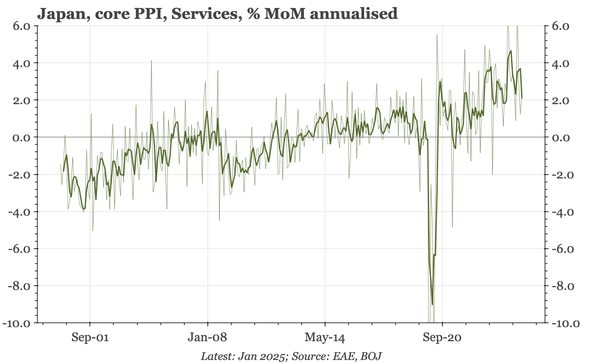
SPPI inflation remains in an uptrend, and is now running around 3.5% saar. A few months ago the BOJ rejigged the data to include a breakdown by labour content, and that shows SPPI rising most quickly in high-labour industries. This will give the bank further confidence in its price-wage story.

1 min read

China – exports remarkably strong, imports notably weak

China – exports remarkably strong, imports notably weak

Export volume strength sustained through end-24. From the low of early 2023, shipments have risen by 30%. That's a growth rate rarely topped in the last 15 years, despite today's headwinds of tariffs and a global market share that is already large. Import growth, conversely, has rarely been weaker.

1 min read

Japan – inflation moving up

Japan – inflation moving up

My estimate of YoY trimmed mean inflation ticked up for the second consecutive month in December. That matters when the Tankan's measure of output prices has been warning the fall-back in inflation since was overdone. The backdrop is international core inflation settling at 2% saar since August.

1 min read

Japan – no JPY boost to export volumes

Japan – no JPY boost to export volumes

Firms haven't responded in textbook fashion to the weaker JPY. While the currency is down 35% since 2019, export volumes have risen just 7%. The reason is export prices haven't been cut, with the weaker JPY instead flowing straight to the bottom line. In JPY terms, exports rose 50% in 2019-24.

1 min read

Japan – household incomes up again in Q3

Japan – household incomes up again in Q3

Today's household sector details of Q3 GDP show real incomes rose for a third consecutive quarter. That seems to bring to an end what had been a terrible period for incomes, and with the labour market remaining tight, suggests last year's recovery in consumption should continue.

1 min read

Korea – consumers still depressed

Korea – consumers still depressed

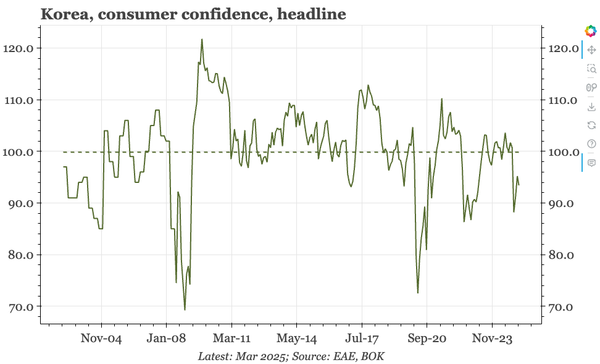
After diving in December, consumer confidence rose in January, but not much. For the BOK it was good news that expectations for property prices softened again, and ticked down for overall inflation. Near-term price expectations rose, but that likely reflects food prices at the beginning of the year.

1 min read

Taiwan – overseas production ratio lowest since 2007

Taiwan – overseas production ratio lowest since 2007

If you want evidence of supply chain shifts away from China, Taiwan's data provides it. Exports and FDI show a big move towards the US and other Asia. In today's export order data for December, the overseas production ratio for IT products fell again, and is now at the lowest level since 2007.

1 min read

China – no change in Q4 deflator

China – no change in Q4 deflator

The Q4 release was tougher to interpret than usual. It included the effect of the upwards revision in nominal GDP level announced at end-2024, but didn't give a back series for revised NGDP for earlier quarters. Today that history was published. The highlight? Still no change in the deflator.

1 min read

Region – modest rebound in import prices

Region – modest rebound in import prices

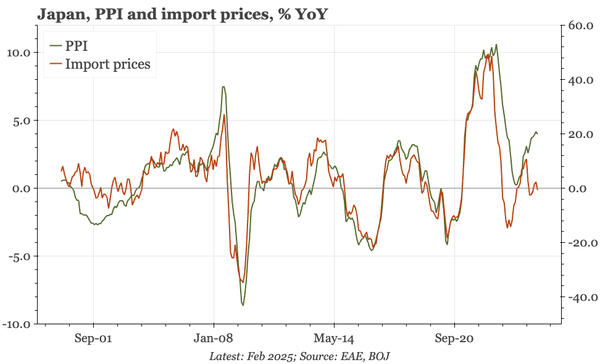
The rebound in import prices is obviously bigger in Korea where the currency has weakened more. Even there, though, the 7% rise is modest compared with the double-digit increases in 2021-22. And the YoY comparison will be dampened in the next few months by the rise in import price inflation in 1H24.

1 min read

Japan – another firm Reuters Tankan

Japan – another firm Reuters Tankan

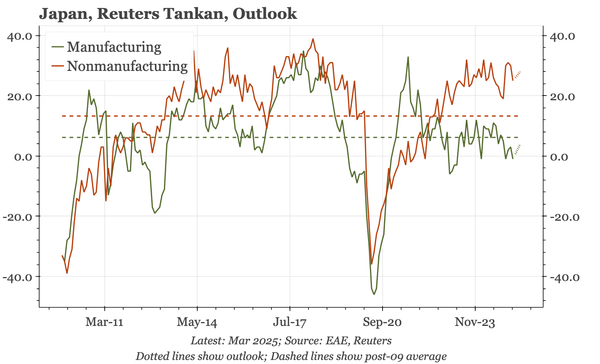
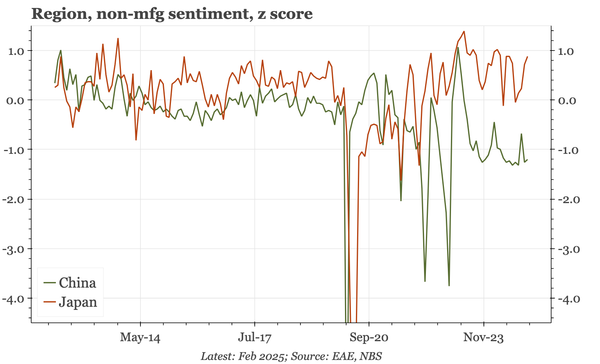
After a dip in 2H24, the non-manufacturing survey is now back to cycle highs. One retailer was quoted as saying: "With high domestic consumer confidence, the number of customer visits....is growing steadily". That's interesting: official surveys don't show consumer confidence is that strong.

1 min read

Korea – nasty employment data

Korea – nasty employment data

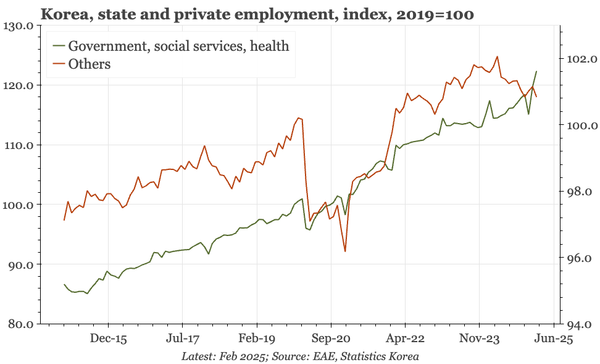
December employment fell sharply, and while that can be explained by the ending of some government jobs projects, it fits with the sharper downturn in the cycle in Q424. That will likely be the focus for the BOK tomorrow, despite other data today showing KRW weakness pushing up import prices.

1 min read

Japan – EW suggests cycle still firm

Japan – EW suggests cycle still firm

The recent up-tick in the monthly Economy Watchers survey persisted in December. The outlook is a bit weaker, but still comfortably above the survey's long-term average. While the cycle isn't booming, it does look solid.

1 min read

China – strong exports, surging surplus

China – strong exports, surging surplus

China's exports rose strongly into year-end, while imports remained flat, sending the trade surplus surging. Maybe there's front-loading to beat Trump II tariffs, but it is notable how resilient China's exports have remained when the Trump I tariffs remain firmly in place.

1 min read

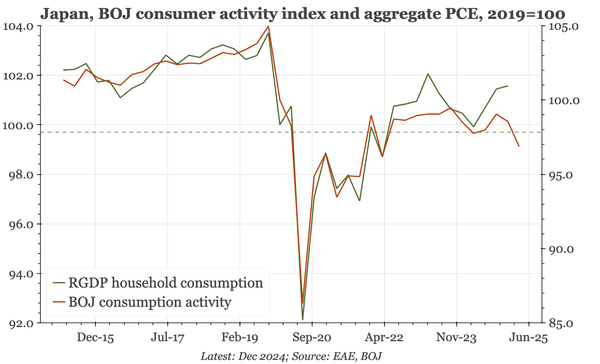
Japan – consumption still soft

Japan – consumption still soft

Data today show consumption still weak. But I don't think this is critical. Ueda recently was talking about better spending, which is clear in per capita terms. The aggregate is held down by the falling population, but that decline is also behind the increasingly clear trend of wage growth.

1 min read

Japan – part-time wage strength

Japan – part-time wage strength

Base pay for full-time workers has plateaued at a bit below 3% since Q324. That loss of momentum isn't especially worrying: in 2023/24 there was a similar pause before real-acceleration. Part-time wage growth continues to trend up, reaching 4.7% YoY in November.

1 min read

Region - Samsung v TSMC = Korea v Taiwan

Region - Samsung v TSMC = Korea v Taiwan

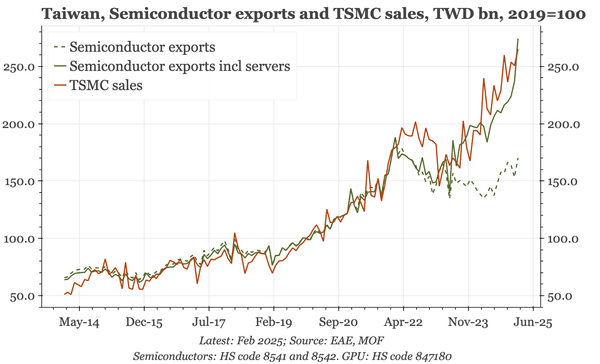
There are other things that explain Korea's economic underperformance relative to Taiwan since 2020, with consumption being one of them. But the stumbles at Samsung are still particularly important, happening while TSMC goes from strength to strength.

1 min read

Japan – a hint of real reflation

Japan – a hint of real reflation

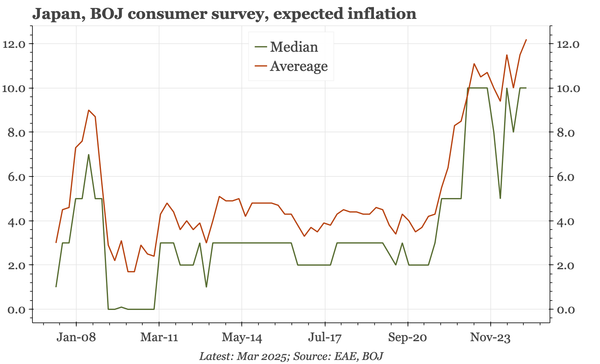
Given the relationship is far from perfect, it would be wrong to read too much into this first chart. However, it is still notable that the rebound in consumer confidence hasn't relapsed despite the continued strength of inflation expectations. That at least gives a hint of substantive change.

1 min read

Japan – part-time wage inflation rising further

Japan – part-time wage inflation rising further

While full-time worker pay clearly matters, it is also important to watch wage inflation for part-timers. That this is already running at 4% illustrates the real tightness in the labour market. There's more upside ahead, with reports that the big retailer Aeon is planning another 7% hike in 2025.

1 min read

Taiwan – still likely on hold

Taiwan – still likely on hold

Headline inflation ticked up in December to back above 2%, but core continued to ease. With property cooling too, the likelihood of further monetary tightening is receding. At the same time, the strength of semi equities and the services PMI mean no urgency to cut either.

1 min read

Taiwan – overseas production ratio lowest since 2008

Taiwan – overseas production ratio lowest since 2008

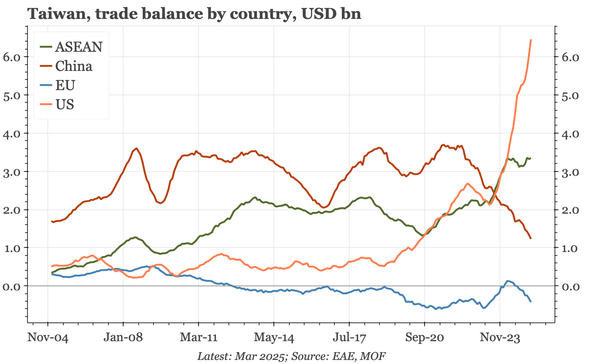
Taiwan's export orders data today show another decline in the overseas production ratio, especially for electronics products. That implies some move in the supply-chain from China, which helps boost Taiwan's growth, but at the expense of more direct trade and a surging trade surplus with the US.

1 min read