Archive
East Asia Econ Paul Cavey

Korea – becoming....East Asian

Korea – becoming....East Asian

Historically, in terms of both savings and inflation, Korea has looked different from the other East Asian economies. But that is now changing. In recent years, Korea has become a clear external creditor, and labour market developments warn of a structural slowdown in inflation.

8 min read

Korea – structural labour market looseness

Korea – structural labour market looseness

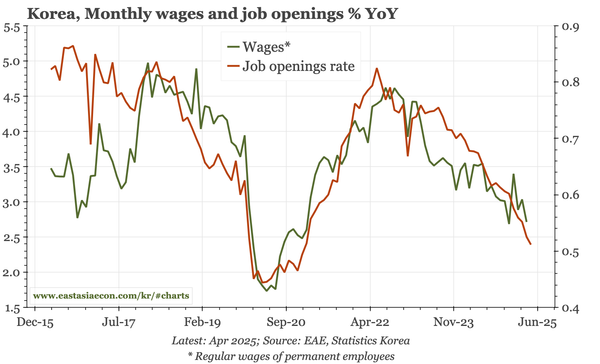
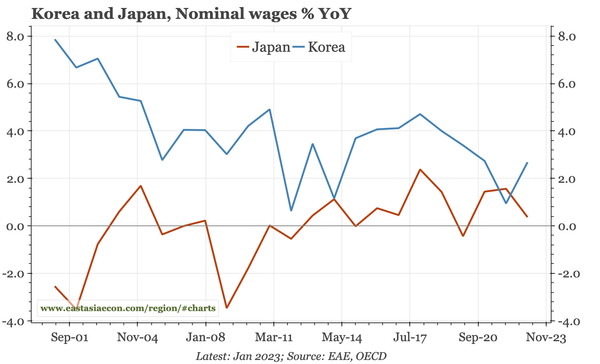
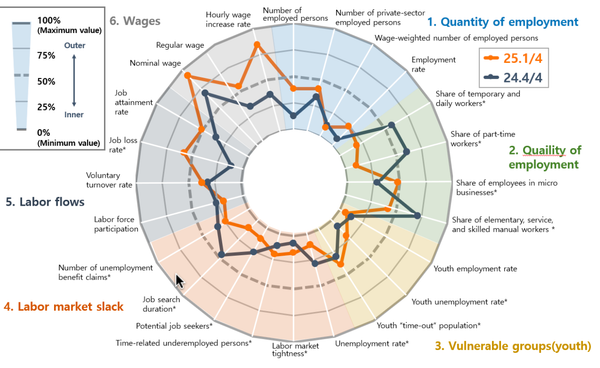
Unemployment remains low, but wage growth isn't accelerating. The reason is the big structural changes in the labour market of recent years, which have increased the number of part-time jobs. That shift is likely to reduce the bargaining power of labour, and generate a structural slowdown in wages.

2 min read

Korea – minutes show cuts ahead

Korea – minutes show cuts ahead

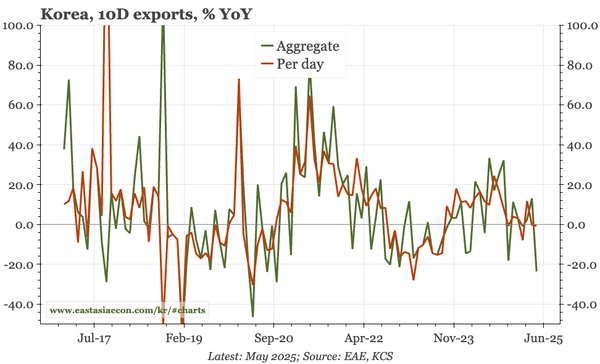
Today's 10D May export data were stable, but that won't ease the growth concerns visible in last week's minutes of the BOK April meeting. It seems the member who voted for a cut was weighing more than 25bp. But another member warned against being "bold", saying that monetary easing wasn't working.

3 min read

Korea – activity weaker than inflation

Korea – activity weaker than inflation

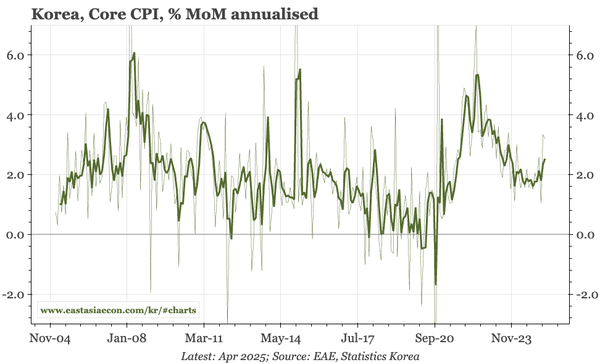
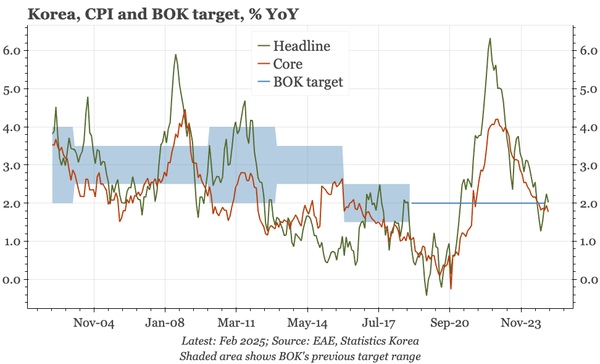
Yesterday's export data for April were sluggish, and today's PMI fell to 47.5, the lowest since September 2022. Ongoing political uncertainty won't help a recovery. The BOK expects this weakness to reduce inflation, but that feed through isn't obvious yet, with April core CPI remaining over 2%.

3 min read

Korea – business sentiment worsens again

Korea – business sentiment worsens again

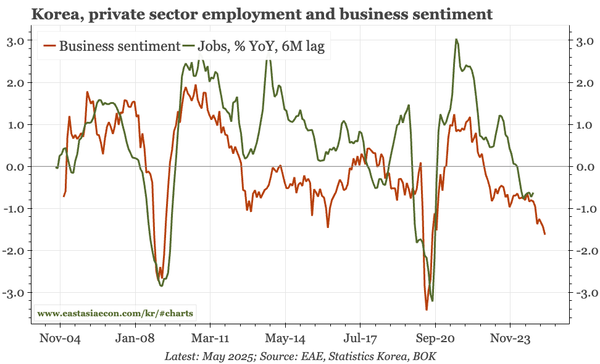
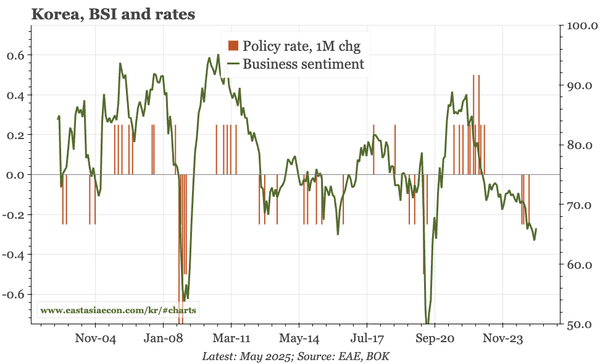
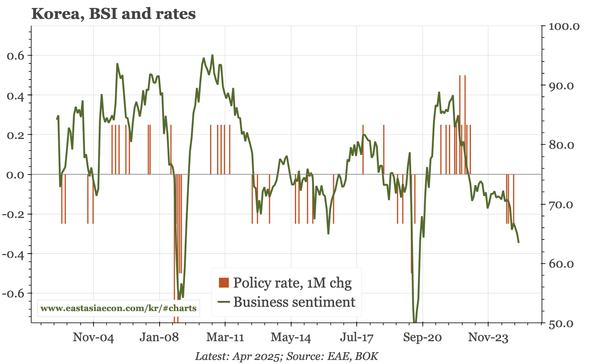
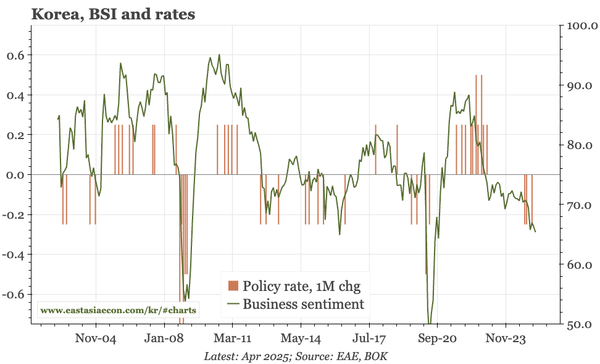
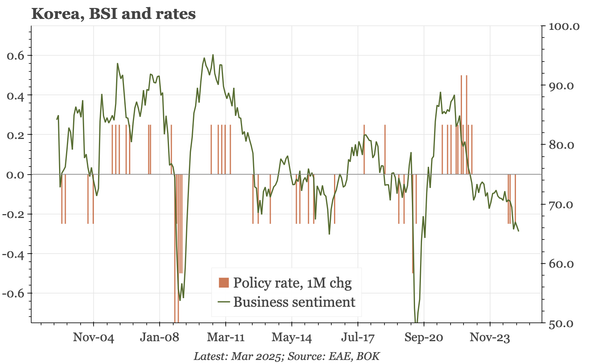
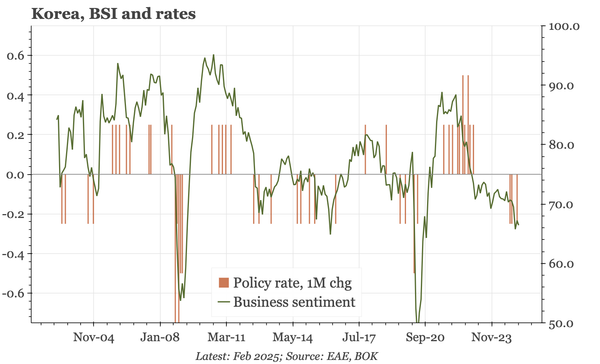
Business sentiment fell again in today's survey, and has now only been worse during the global financial crisis and covid. Exporter sentiment has ticked-down, but the weakness is much more apparent in domestic, non-manufacturing sectors. Further policy easing is ahead.

2 min read

Korea – cycle worsening, rates to fall

Korea – cycle worsening, rates to fall

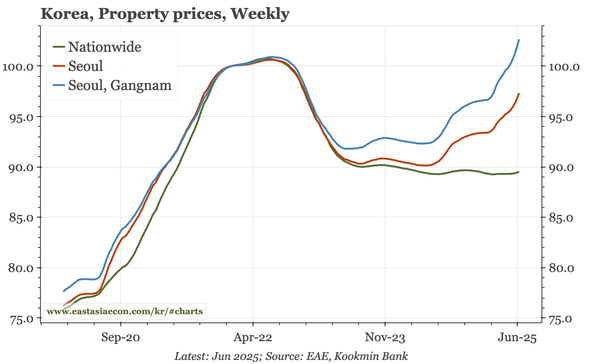
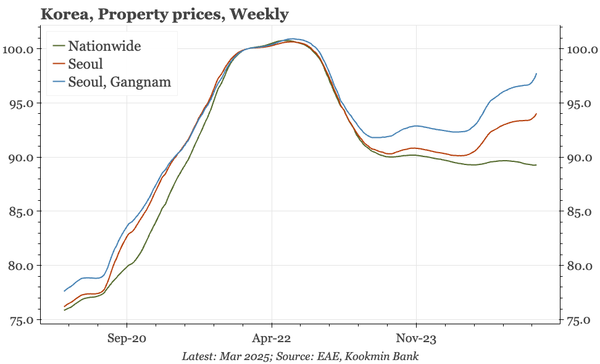
The economic environment for Korea is about as bad as it can get. Despite the short-term rebound in house prices, that suggests more rate cuts, starting at this week's meeting, that will ultimately take the policy rate below neutral. The one caveat I have is the stickiness of services inflation.

5 min read

Korea – core inflation up again

Korea – core inflation up again

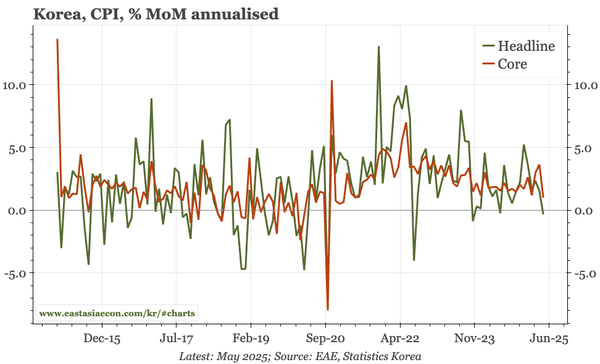
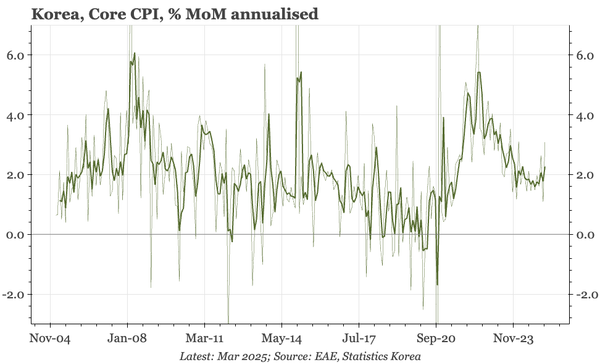
With public services prices rising in March, the upwards drift in private services prices of recent months is now showing in core inflation. It still isn't high, but with business surveys suggesting some pressure on goods prices too, inflation is becoming more of a constraint on BOK action.

2 min read

Korea – sentiment drops again

Korea – sentiment drops again

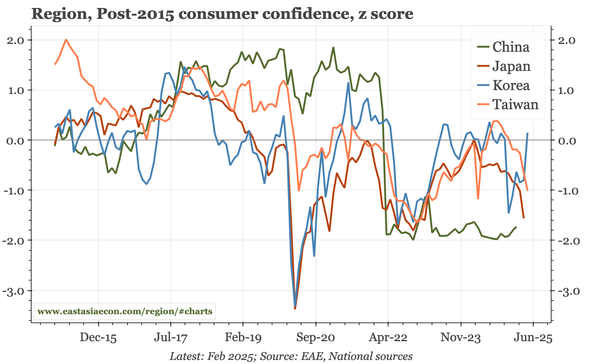
Business confidence remains extremely weak, and consumer confidence isn't a whole lot better. That being the case, the BOK is going to want to cut further, but inflation readings in the sentiment surveys aren't giving the all-clear for an aggressive loosening.

2 min read

Korea – BOK remains dovish

Korea – BOK remains dovish

Tuesday's minutes of the February meeting show concern about weak growth. The impact of higher $KRW on inflation was played down, and the committee didn't discuss the rising services prices that have worried me. Perhaps not surprisingly given rates were cut, household debt was back on the agenda.

2 min read

Korea – activity weak, property inflation re-accelerates

Korea – activity weak, property inflation re-accelerates

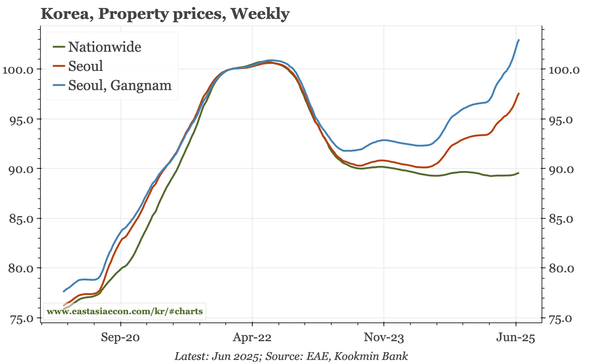
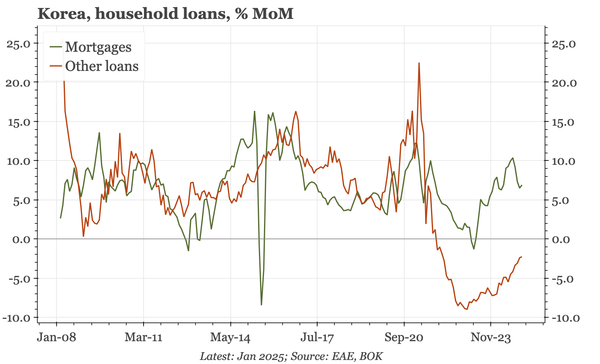
There's no change in weak activity, and that even before Trump's reciprocal tariffs. The KRW has been stable, but the warning signs of a rebound in property have been accurate. The direction of policy rates is still down, but household debt issues will once again complicate the outlook for the BOK.

4 min read

Korea – BOK cuts, and hopes for fiscal

Korea – BOK cuts, and hopes for fiscal

For the third time since October, the BOK cut rates today. It expects to cut rates further, and although one dynamic affecting the scope and timing will be house prices, the bank also hopes for fiscal policy, which is the one driver it can identify that could serve as an "upside factor for growth".

2 min read

Korea – still in a cutting cycle

Korea – still in a cutting cycle

As it did in January, a BOK cut next week seems likely. Of course, the bank didn't cut in January, so this forecast risks whiplash. But to turn market pricing, the bank would need to indicate an end to loosening, which is unlikely unless it highlights household debt or services inflation.

4 min read

Region – an illustration of Korea's export problems

Region – an illustration of Korea's export problems

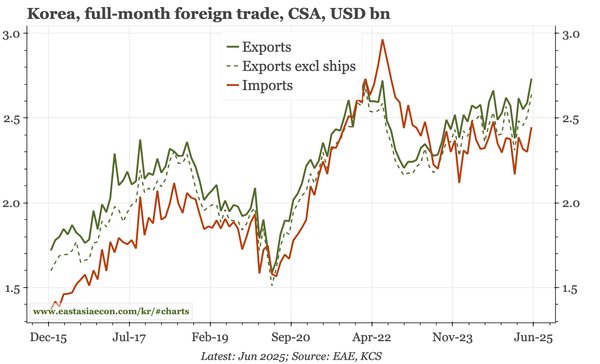
This is a shorter thematic note than usual. In the longer piece last week, I didn't come up with a chart that nicely summarised Korea's export challenge. I think I have it now. While Korea is holding on in DM, it is losing market share just about everywhere else, being pushed out largely by China.

1 min read

Korea – weak in Q1, worse in Q1

Korea – weak in Q1, worse in Q1

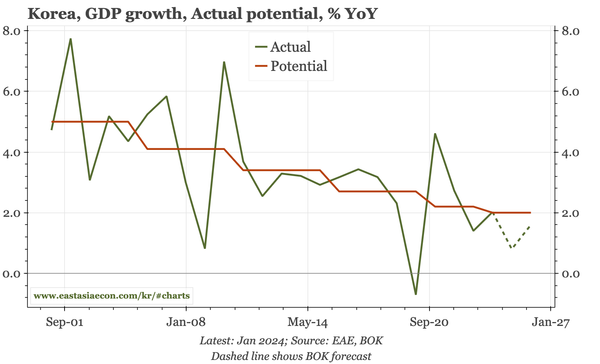
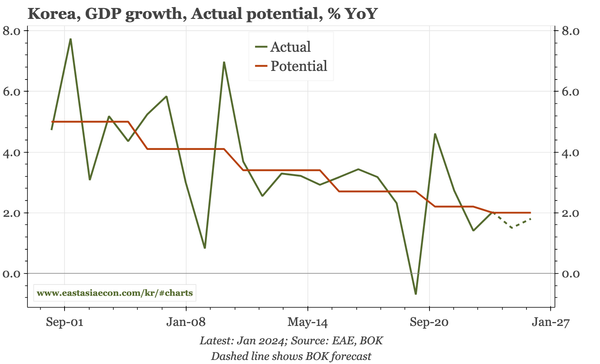
Today's GDP release shows Korea's economy only grew in Q124. After that, activity stagnated. Q125 is likely to be worse, given the collapse of domestic confidence after the martial law fiasco, a deterioration confirmed by the BOK's confidence surveys that were also released the last couple of days.

2 min read

Korea – doveish hold

Korea – doveish hold

Contrary to my thinking, the bank didn't cut today. The reasoning – KRW weakness and political uncertainty – wasn't a shock. However, the tone of the meeting was very doveish, with the bank talking about "intensified" downside risks to growth. Korea really looks very different to Japan and Taiwan.

2 min read

Korea – re-quantifying the BOK's reaction function

Korea – re-quantifying the BOK's reaction function

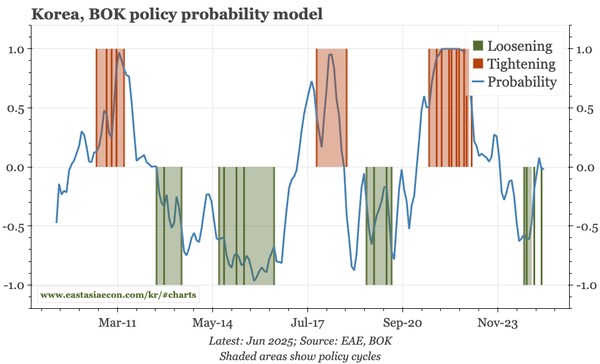
I've revised my model for the BOK's reaction function. That suggests the probability of loosening tomorrow is about the same as the Q4 meetings when rates were cut. Considerations for later in the year are yesterday's SLO survey warning of a rebound in housing, and firm services CPI.

3 min read

Korea – another step lower

Korea – another step lower

Recent data and the minutes of the November BOK meeting offer a good opportunity to look at Korea in light of the latest bout of political turmoil. The conclusion: a weak cycle is getting weaker, and so exchange rate depreciation is unlikely to stop the BOK cutting further.

5 min read

Korea – exports weak, employment stable

Korea – exports weak, employment stable

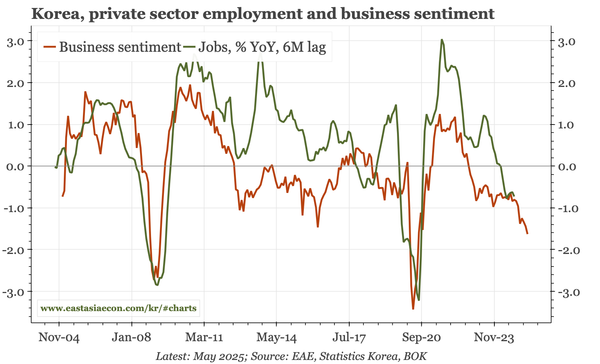
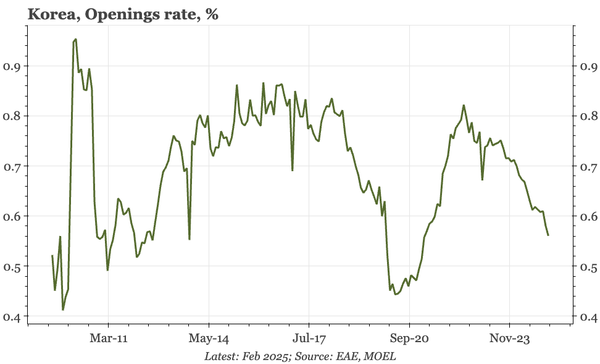
Today's headline employment data were stable, but the details are weaker, and the weakness in business confidence points to employment falling in 2025. Separate export data for the first 10 days of December show momentum remaining weak.

2 min read

Korea – private services inflation still edging up

Korea – private services inflation still edging up

Headline November CPI data don't challenge the BOK's confidence that inflation is under control. But private services inflation continues to creep up, with SAAR now above 3%. That core has remained around 2% is because of cheaper public services. With budget tightening, that seems tough to sustain.

2 min read

Korea – BOK acts on growth

Korea – BOK acts on growth

As expected, weak growth is now the BOK's main concern, with the bank reacting by cutting rates for a second consecutive time. The bank was already feeling confident about CPI, and worries about property have now also receded. If planned measures constrain $KRW upside, further rate cuts are likely.

2 min read