Paul Cavey
China – prices and demand deposits stable
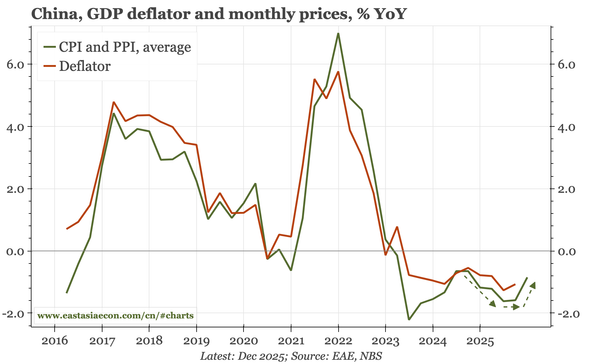
The FAI data point to the economy hitting a wall. But price data don't bear that out. Indeed, upstream prices show the recent stability of PPI is likely persisting. That is also true for the demand:time deposit ratio. The cycle as a whole remains both weak and messy, but there are some green shoots.
Last week, next week
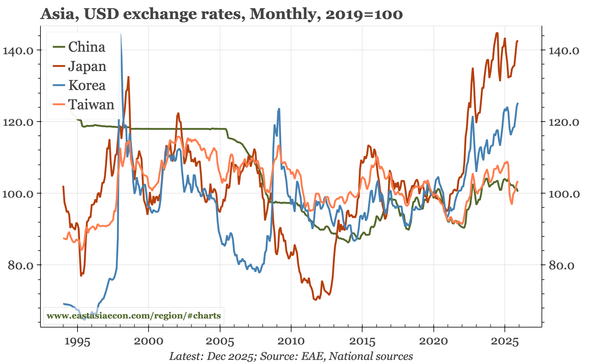
Japan is doing macro stimulus when the cycle really doesn't need it. China isn't doing any when the cycle still does. The first keeps the JPY weak. The second prevents the CNY from appreciating. Both in turn weigh on the KRW and TWD, despite substantial current account surpluses across the region.
East Asia Today
The big releases today were Japan CPI and trade for October and November PMIs, and Korean October PPI and exports for the first 20 days of November. Also, a longer note on Korean capital flows, and an update of the detailed trade data for China shown in our interactive dashboard.
Korea – household offshore equity buying and the KRW
Global factors like US rates and JPY weakness are dragging down the KRW. But there are also local drivers, particularly Korea's big buying of overseas equities. For both the NPS and households, I would expect that to slow, with the reversal likely to be sharp if global markets really sell off.
East Asia Today
A quiet day for data today, with only machine orders in Japan and Korean IIP data for Q3. The IIP data are interesting, showing Korea's structural emergence as an international creditor. I would have expected that to put a ceiling on $KRW, but that impact really hasn't been obvious in recent months.
East Asia Today
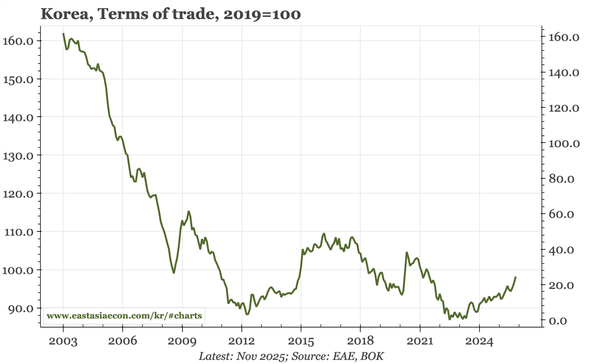
A longer piece looking at whether the rise in DRAM prices means Korea macro in 2026 will look like Taiwan macro in 2026. Also, household credit data in Korea (a bit slower), and more detailed October trade data for China, showing that while exports overall were weak, shipments of cars weren't.
East Asia Today
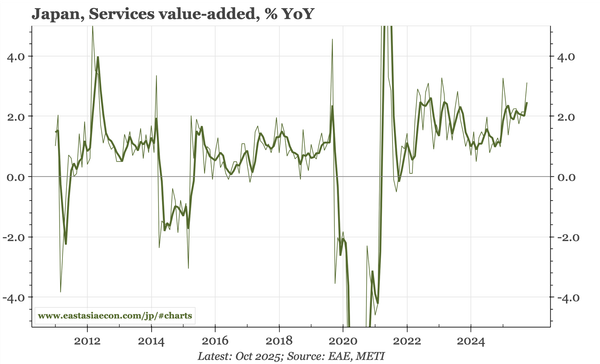
China's IP and services activity were stable in October, but were over-shadowed by another big drop in FAI. That can't be entirely dismissed, even though the data aren't so reliable. In Japan, services activity continues to trend up. In Korea, import prices are rising, but so are semi export prices.
China – not yet soft enough
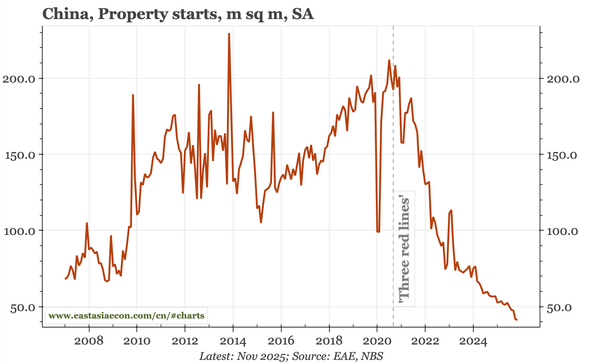
The October data are soft, but mixed: on the one hand investment terrible and property weak, on the other, output and services more stable. That probably doesn't add up to a change in policy. My idea of stabilisation does look a bit more tenuous, and would be over if upstream prices give way again.
Korea – watching semi export prices
Import prices are rising, but not by enough to think upstream inflation is about to explode. More interesting are export prices. Auto export prices aren't rebounding. By contrast, semiconductor export prices seem to be gaining upwards momentum – which is important given the rise in spot DRAM prices.
East Asia Today
Today's releases show Japan PPI turning up, and China credit growth slowing down. Also today, my latest data visualisation tool, mapping China's provincial data. The first data covered is FAI, showing the weakest province in September to be Guangdong, which would usually be regarded as a powerhouse.
China – monetary data a bit softer in October
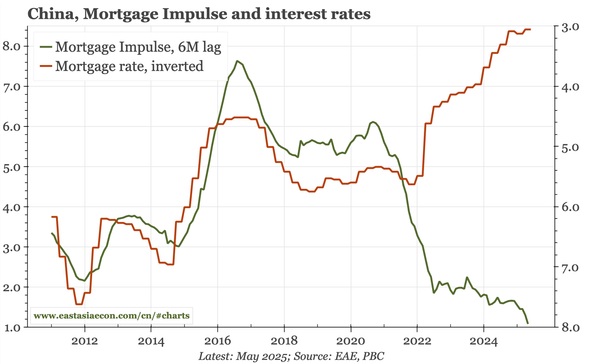
Relative to my idea that the underlying economy could be stabilising, today's monetary data for October are a little soft. In particular, both M1 growth and the M1:M2 ratio ticked down, and mortgage lending also slowed. Credit growth also dropped, but only because of less government borrowing.
Japan – PPI still rising
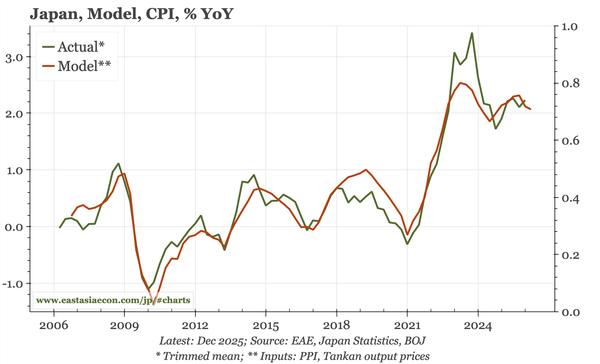
The gap between import prices and PPI in the October data illustrates the sort of pent-up inflationary pressure in Japan that is likely to be exposed if the JPY remains so weak. Today's data also show a decent rise in auto export prices, but to a level that is still 6% below the pre-tariff level.
East Asia Today
The continued fall in interest rates in the real economy shown in yesterday's monetary policy report from the PBC, another strong sentiment survey in Japan, and some thoughts on Korea in light of yesterday's minutes of the October BOK meeting and today's labour market data.
Korea – "financial dominance"
With October meeting minutes, export and labour market data, there's enough to review the outlook for Korea. I think the underlying economic picture remains consistent with more cuts. But the minutes show Board members continuing to prioritise concerns about KRW weakness and house price strength.
East Asia Today
Some strong numbers in Japan today, both the Economy Watchers survey – which provides a good guide to the direction of the cycle – and the current account surplus, which in September was the highest in at least 25 years. Also today, Korean export data for the first ten days of November.
Japan – EW survey lifts strongly
The sharp recovery in sentiment in the EW survey continued in October. The improvement is broad-based, affecting both corporates and households. That shows a lessening of the tariff and inflation shocks of 1H25, and should be reflected in the BOJ becoming more optimistic about the outlook.
Japan – Board thinks the time for another hike is getting closer
The summary of the October BOJ meeting show a stronger consensus that the time is approaching for another rate hike. That is partly because concern about tariffs is fading. It is less about domestic demand: data today show consumption trending up, but still only very slowly.
Last week, next week
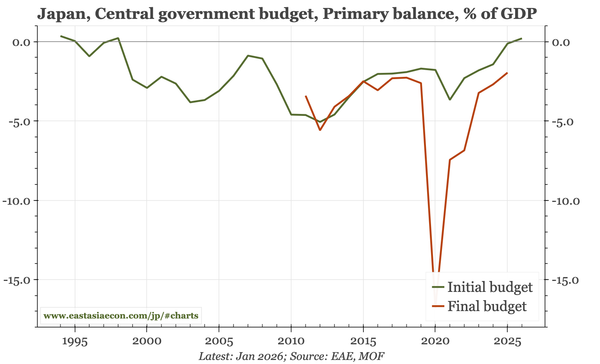
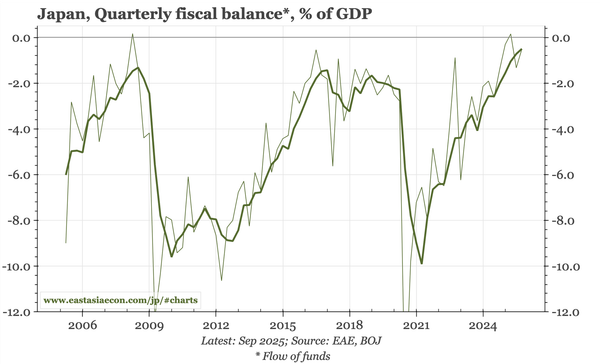
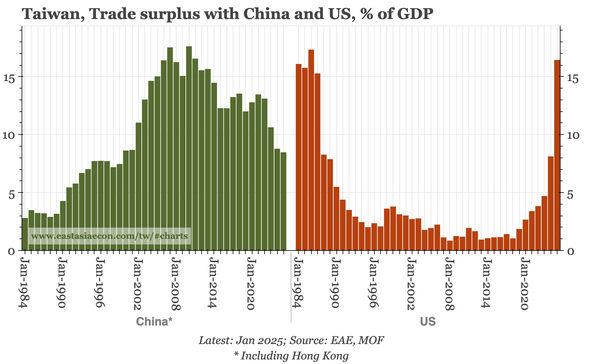
Data last week showed Taiwan remaining as one of the world's major beneficiaries of AI adoption. A big question for 2026 is whether Korea joins the party. Other themes are fiscal uncertainty in Japan, and further signs of stabilisation in China's underlying cycle.