East Asia Today
In Korea, we've had the BOK minutes (published yesterday), and June JOLTS data. In Japan, the only releases have been 10D trade data for July and June Toyota sales. China's July Politburo was also released. That doesn't look to contain surprises, but I'll be going through it later.
Taiwan – further softening of LIs
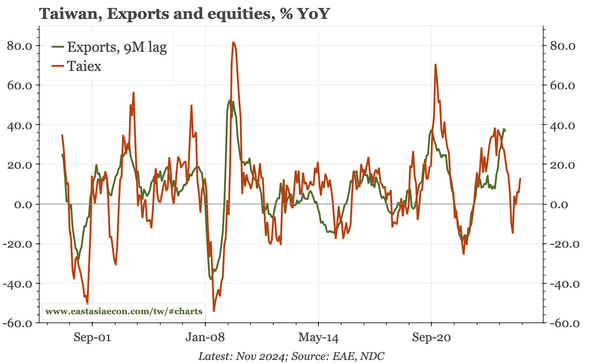
The clear conclusion from the official leading indicators is that the cycle has peaked. However, given that exports always had to slow from the absolute surge in 1H25, that isn't news. The difficulty in 2H25 will be differentiating normalisation after that surge from a real cycle deterioration.
China – little relief from deflation
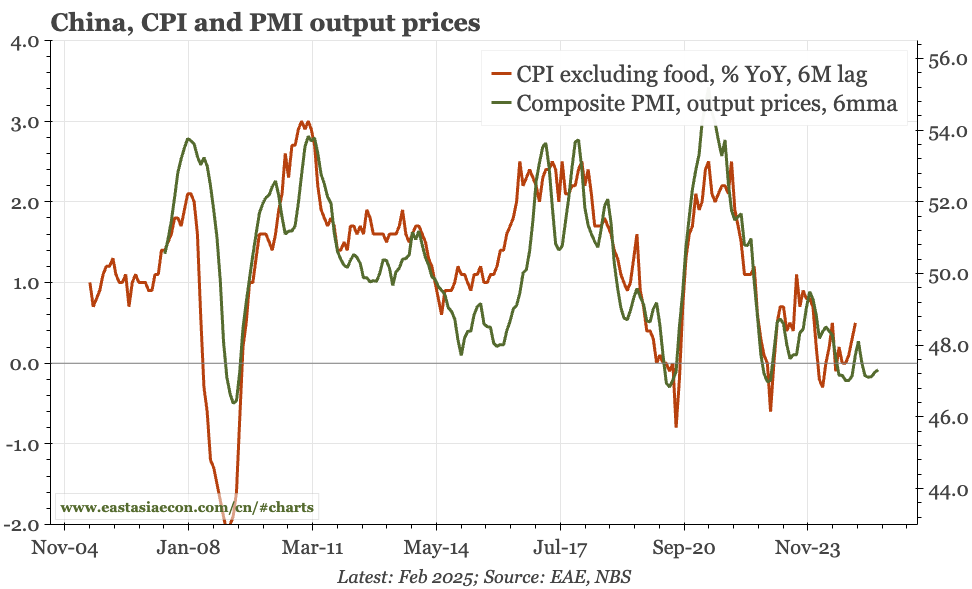
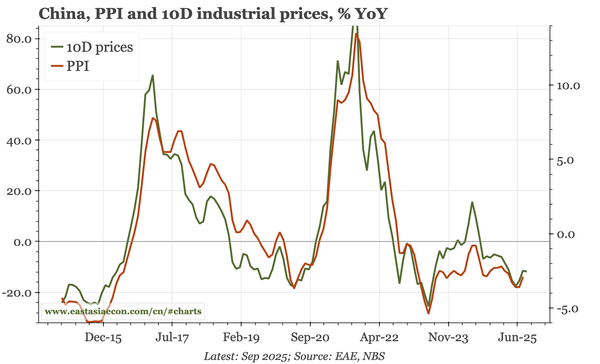
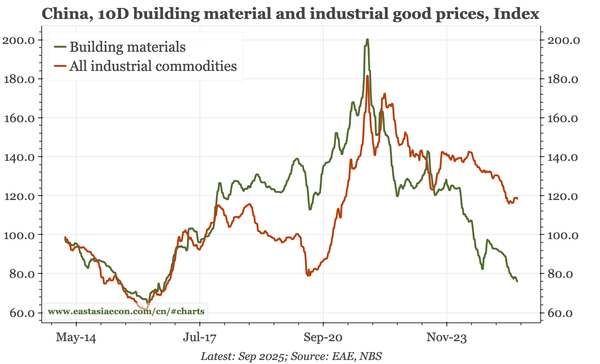
Data through July show upstream industrial prices have stopped falling. That should mean PPI deflation doesn't worsen further. However, underlying demand remains weak, with building material prices continuing to fall. And soft wholesale food prices suggest there's no pick-up in CPI either.
Japan – services still strong
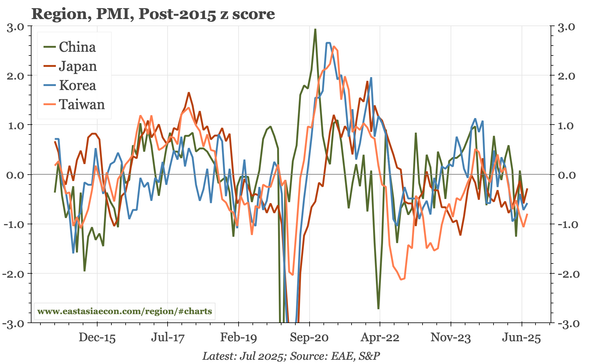
Japan's post-covid cycle has had two clear features. First, the strength of services and non-manufacturing. Second, inflation. Today's flash PMI shows both those trends persisting. Sentiment fell in manufacturing, but improved in services, while input price inflation remained "sharp".
Taiwan – IP and exports outweigh everything
IP dipped in June, but is still 40% above the trough of 2023, 100% higher than 6M ago, and dwarfs the cycle in Korea. The surge in IP/exports has supported the domestic economy when consumption has been weakening. The cycle thus remains unusually desynchronised, as it has been since the pandemic.
Korea – exports ok in July
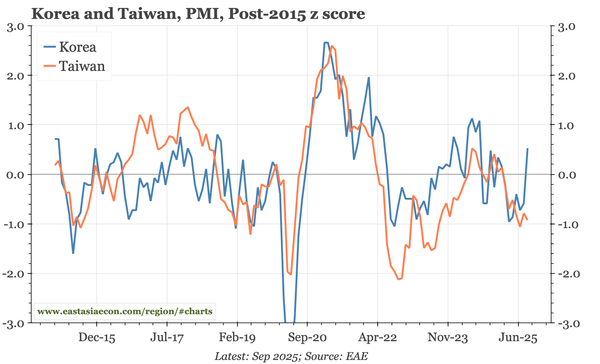
While easing in the first 20 days of July, exports didn't fully reverse the June bump. In the circumstances, that's not bad, though only semi shows any real momentum, and it seems unlikely anything else turns up given tariffs. Exporter sentiment in this week's business survey will tell us more.
China – auto exports regain momentum
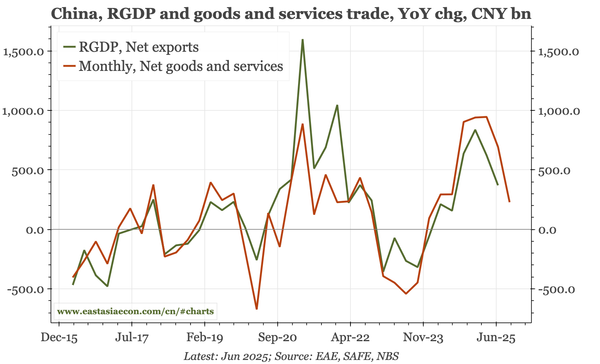
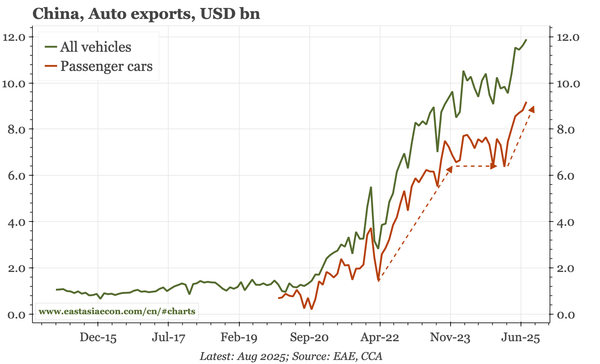
The rise in exports and the trade surplus clearly isn't just about autos: there's now a large surplus in all major mfg categories. Auto exports in fact went sideways in 2023-24 as the initial rise driven by ICE shipments lost momentum. But there are now signs of a second wind, due to EVs and hybrids
China – property weakness still dragging down prices
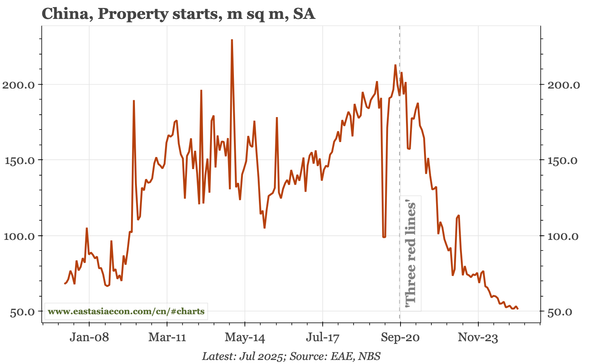
Overall, the big recent drop in upstream prices has stabilised. But for building material prices, there's no respite, now being lower than any time since 2016. That shows the ongoing weakness in the property sector, which none of the policies of the last few years have managed to turn around.
Japan – machine order lower in May
Core machine orders dropped in May. It would be easy to think that was tariff related, but it really is too early to tell. The data are volatile, April was particularly strong, and May is still above the pre-April level. Still, the data do feel soft, though more because of softer domestic orders.
Korea – June export surge fades in July
The pop in exports in June faded in the first part of July. That was perhaps because the pop in the DRAM price eased as well: semi exports have risen again in July, but at a slower pace, and exports of other products still aren't doing much. In terms of countries, there's also no big change.
Taiwan – cycle lifting wages and productivity
Wage growth slowed in May in manufacturing, but the trend is still up, and in recent months it has been firm in services too. That CPI is slowing is partly due to the TWD, and partly productivity. In separate news, TSMC's sales were softer in June, but financial markets don't seem concerned.
Japan – one shock eases, but the other intensifies
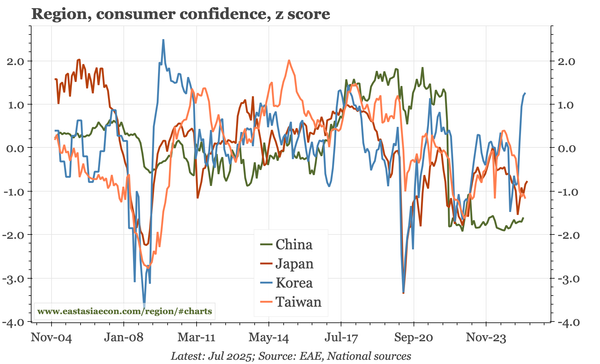
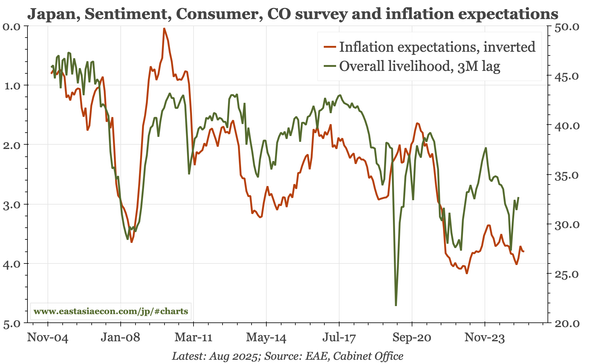
Japan in 2025 has suffered two negative shocks: tariffs, and a rebound in CPI that's eroded real incomes. June surveys, such as today's EW, show the household mood starting to improve as the price shock wanes. But that won't matter if Trump proceeds with the yet higher tariffs he's now threatening.
China – PPI deflation likely worsened further in June
10-day industrial prices ticked up a bit at the end of June, helped by energy. But building material and ferrous prices continued to drop, and with the higher base from last year, it still seems likely that next Wednesday's data will show headline PPI deflation worsened again in June.
Taiwan – another hefty rise in fx reserves
At USD5.5bn, June's rise in reserves wasn't as big as May's USD10bn. But it is the first time since 2020 that reserves have grown by over USD5bn for two months running. If lifers/corporates are less willing to recycle the rising trade surplus, the CBC has to step in – or the TWD strengthens more.
China – still no activity or price momentum
In the Caixin services PMI, like the official version, both data and anecdotes are weak. "Staffing levels were lowered in June...linked to a slowdown in new order growth and concerns over costs", and "intense market competition" led to selling prices being cut at the sharpest pace since April 2022"
China – still no rebound
The Caixin PMI rose above 50 in June, but only to 50.4. Comments remained cautious. "Firms were generally cautious with hiring on the back of cost control". A "fourth monthly reduction in average input costs" was shared with clients, "resulting in another decline in average selling prices measures"
Taiwan – consumer confidence and leading indicator down
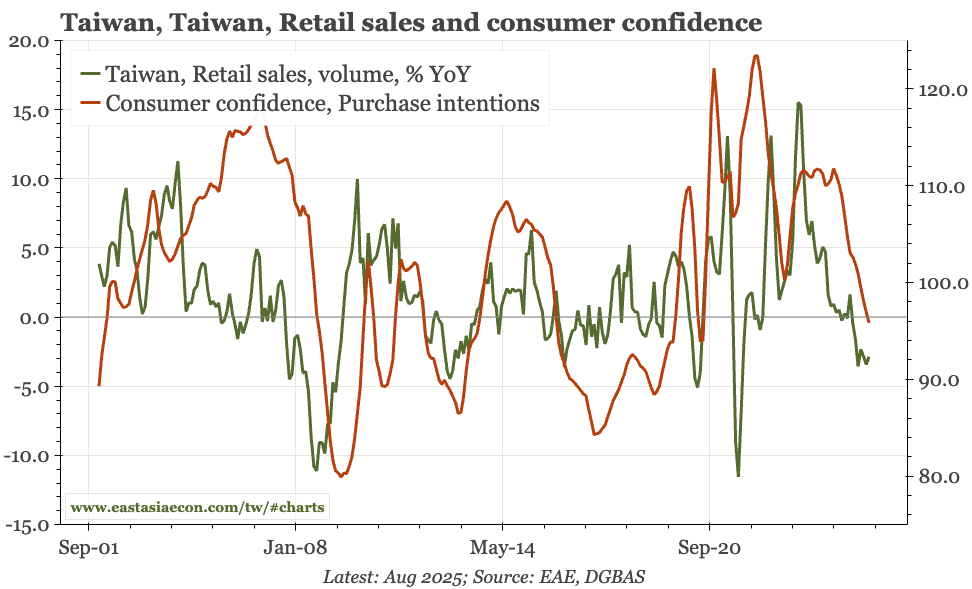
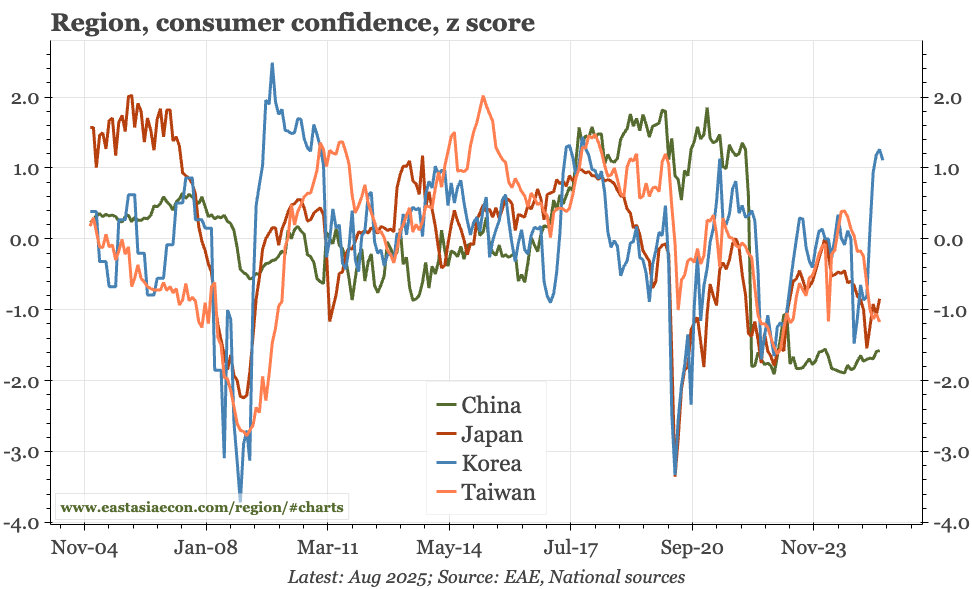
Consumers aren't sure that inflation is easing, with price expectations remaining strong in June. But with consumer confidence down and other data today showing the monitoring index falling, the CBC won't be thinking inflation is about to bounce back.
Taiwan – tech boosting NIIP, but not the TWD
Data today show Taiwan's NIIP surplus dropped a little in 2023, but remained extremely large. Those assets have been accumulated via strong exports, 60% of which are now "high-technology". And yet, the TWD through April weakened, with one measure of the REER no higher than 2001.
Taiwan – wage growth remains strong
Relative to history, Taiwan's wage growth remains strong. As would be expected, that's being led by manufacturing, though services wages have been firm too. For now, the downside for rates remains a structural appreciation of the TWD, not a problem with the cycle.
Japan – PPI starting to decline
PPI inflation eased in May, falling to 3.2% YoY, down from the recent peak earlier this year of more than 4%. The ongoing decline in JPY-denominated commodity prices shows this process has further to go, but feed-through into PPI will likely be dampened as importers try to restore profit margins.
Taiwan – TSMC still leading the way
May was a bit softer for TSMC, but sales are still 26% higher than at the beginning of the year. That matters a lot for the overall economy, given that semiconductors are about 50% of exports, and outside of semi, exports aren't growing much, if at all.
Taiwan – exports still going straight up
The sharp reversal in exports expected by the government isn't showing up yet. Shipments rose strongly again in May, and are now 17% higher than in December. With imports weaker last month, the trade surplus increased to near 20% of GDP, a new multi-decade high. The biggest driver remains the US.
Japan – sentiment back to average
Sentiment in the Economy Watchers survey still points to slower GDP growth in 2H25. However, it now isn't particularly weak, improving in May back to the long-term average of the survey. That's probably not enough for the BOJ, but likely would be if Japan can now land a trade deal with the US.