East Asia Today
Once again, the key theme in today's data releases has been inflationary pressure, seen in Japan's Tankan and the regional PMIs. By contrast, activity proxies haven't moved much. Korea's trade data help explain why: export growth in March was strong, boosted again by chip sales.
East Asia Today
Inflation is the theme, with the rise in prices in the China March PMIs, and two documents released by the BOJ yesterday. In other data today, Korean output was stronger in February. I'd worry about holiday distortions, though a turn in construction can also be seen in the BOK's sentiment survey.
East Asia Today
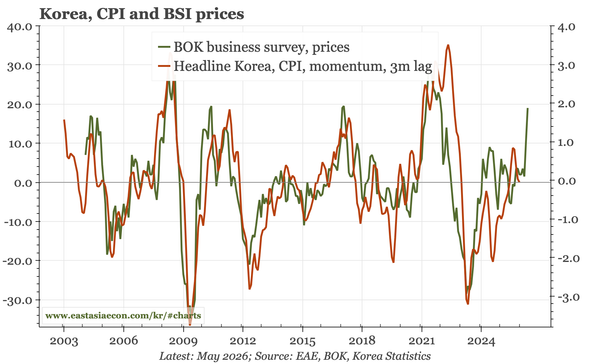
The impact of the oil price spike is starting to be seen, with inflation expectations rising and sentiment falling in the business survey in Korea, and the consumer survey in Taiwan. Also today, 10-day exports and underlying inflation in Japan, and profits in China. In total, 24 charts.
East Asia Today
Like goods PPI, services PPI inflation in Japan has slowed. However, energy prices will now push up goods prices, while wages point to upstream services inflation re-accelerating too. Taiwan's labour market remains tight, with the unemployment rate dipping to 3.3% in February.
East Asia Today
While governments are using subsidies to lessen the impact, today's Korea consumer confidence survey suggests the Iran war might already be boosting inflation expectations. In other news, Taiwan remains the relative loser in tourist arrivals, though that is offset by the strength of goods exports.
East Asia Today
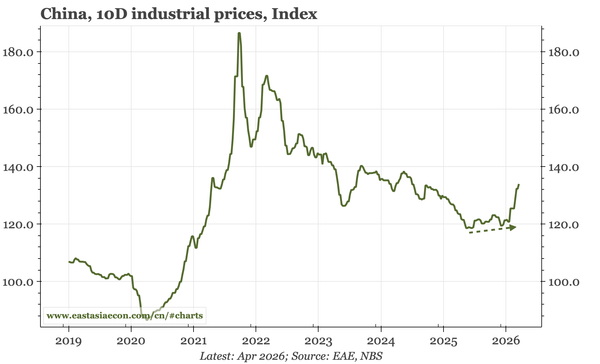
High-frequency price data in China suggest that PPI might turn positive this month for the first time since 2022. In other releases today, underlying CPI inflation and sentiment in Japan remains firm, services prices boosted PPI in Korea in February, and IP in Taiwan last month was strong once again
East Asia Today
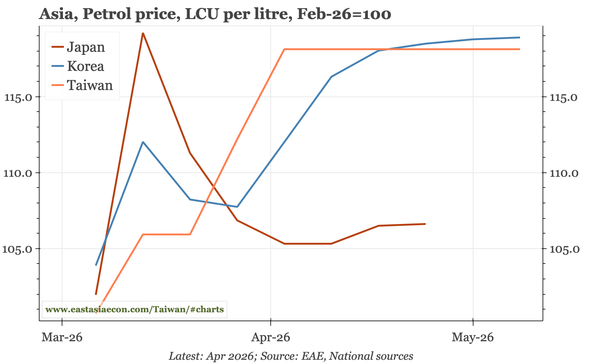
Gasoline prices across the region are rising, but much less slowly than the increase in crude prices. Data through the first 20 days of March show only a modest rise in energy imports so far in Korea. At the same time, chip exports have continued to grow, pushing up the trade surplus.
East Asia Today
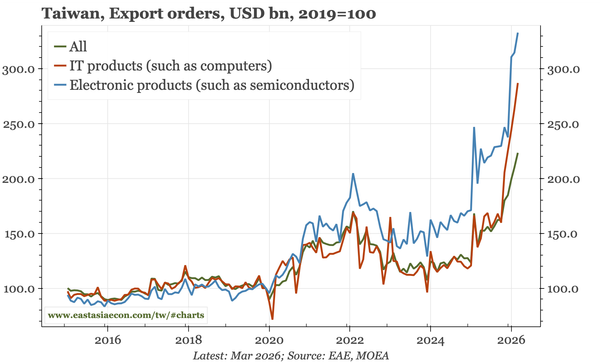
It isn't worth paying too much attention to China's detailed trade statistics for Jan-Feb, given new year distortions. That said, the trend rise in capital goods imports is an under-appreciated shift. Tourist arrivals in Japan remained strong in February, as did Taiwan export orders.
East Asia Today
As expected, no change in policy from either the BOJ or Taiwan's CBC in today's monetary policy meetings. Concerns about inflation are greater in Japan, which makes sense given firm CPI and an improving cycle. The theme for the CBC remains strong growth and modest price increases.
East Asia Today
Flow of funds data show ongoing improvement in Japan's fiscal position through end-25. Exports ticked down in February, but because of Chinese New Year rather a new step-down. Employment in Korea rose in February, but the more noticeable change is the further rise in the female part rate.
East Asia Today
While all the main China Jan-Feb indicators came out today, I think the more important releases were the weekend data showing a further rise in upstream prices, and fx settlement showing continued capital inflows. In Taiwan, wage growth slowed in January, but that is probably holiday related.
East Asia Today
The annual survey of firm behaviour in Japan's shows the structural rise in inflation expectations is continuing. Today's official February PMI in Taiwan points to higher input prices even before the oil price hit. Like the rest of the region, the PMI also shows strengthening cycle momentum.
East Asia Today
Today's quarterly business sentiment survey from the Cabinet Office and MOF in Japan shows the same bounce in manufacturing confidence that has been visible in the different monthly surveys. Korean job openings for January were weak, but that could reflect this year's rebasing of the data.
East Asia Today
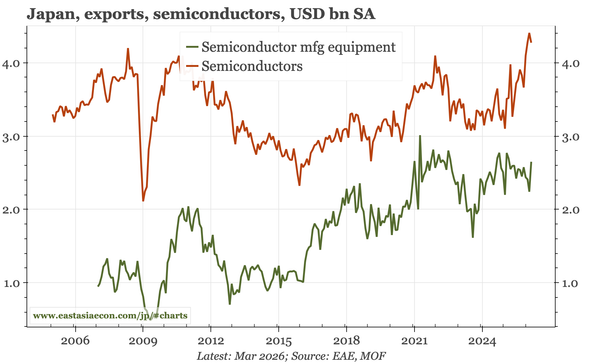
The big dynamic in Asia in early 2026 has been the strength of the semi cycle. That can be seen in today's Japan February export prices, and Korea March 10-day March exports. That provides some offset to the rise in energy prices, though not enough to matter if the Strait of Hormuz remains closed.
East Asia Today
Jan-Feb trade data for China were strong, but still distorted by LNY. Q4 GDP in Japan was revised up, boosted by rising private domestic demand. Korean GDP contracted in Q4, but an improving ToT boosted real incomes. TSMC sales dipped in February, but equities don't yet point to a big downturn.
East Asia Today
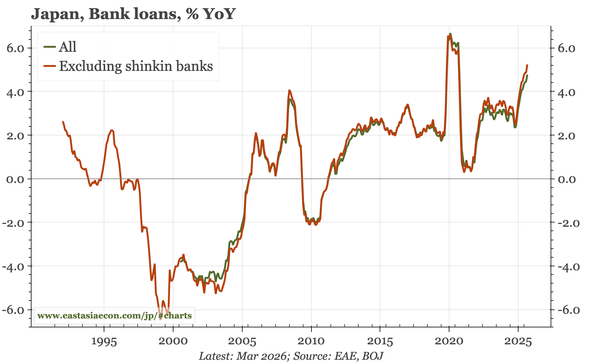
A few data releases today: inflation in China; economic sentiment, bank loans and BOP in Japan; foreign trade and monitoring index in Taiwan. The lessening of deflation in China is an underlying change. The other data are distorted by the Chinese New Year, and will now be shifted by the Iran war.
East Asia Today
While the big news is the bloodbath in markets, particularly Korea, there were lots of data releases today. They show that before the Iran war, economic momentum was good in Japan and Taiwan, and poor in Korea. In China, it could be either, depending on which PMI you believe.
East Asia Today
Lots of charts on Japan, on profits, capex, and unemployment. Also, highlights from today's PMI for Korea. That is solid, but not as strong as in Japan and Taiwan. Like Taiwan, however, the Korean PMI points to rising price pressures β and that even before a new oil price shock.
East Asia Today
A few secondary data points in Japan: Tokyo CPI, retail sales and IP. Also, with both Korea and Taiwan releasing January data, a couple of charts on tourism. Finally, just to let you know that I am travelling the next couple of weeks. The daily will still appear, but there might be some disruption.
East Asia Today
The big policy event today was the BOM meeting. The big data release was Taiwan's Q4 BOP data, showing a huge current account surplus. Also worth noting today are trade data for Japan for the first 10 days of February. And we also have a new video, discussing the cyclical outlook for China.